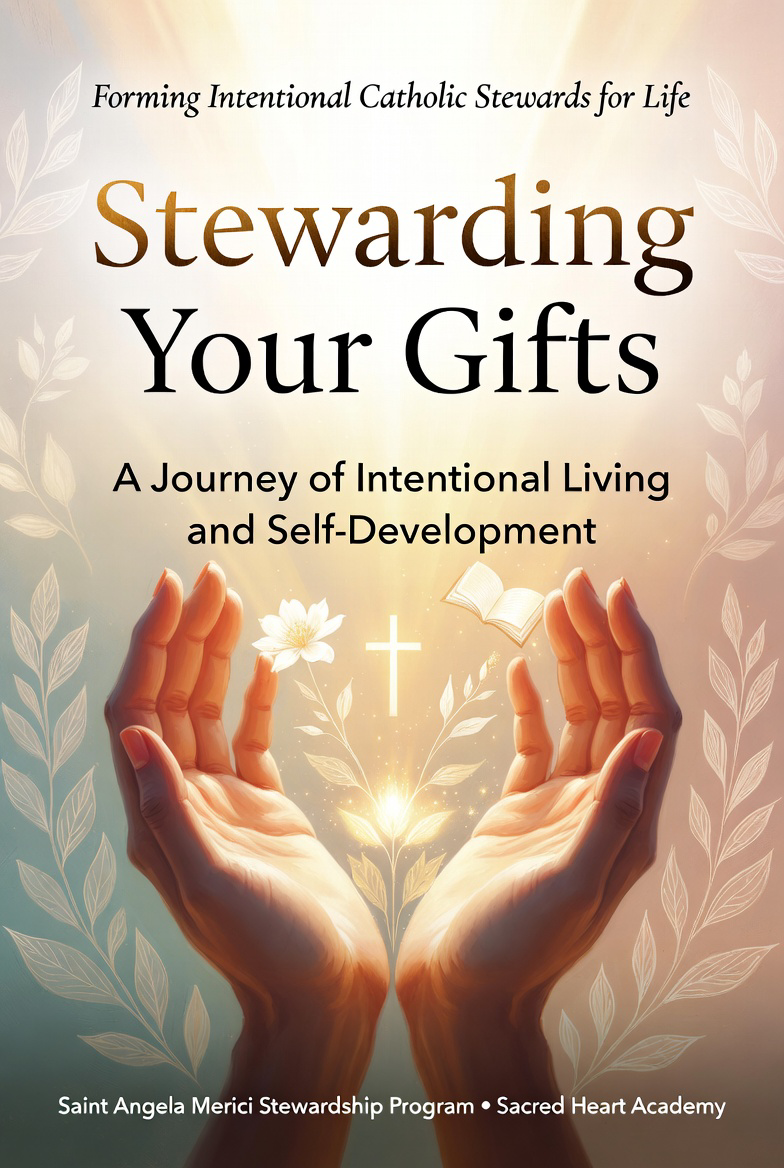
This workbook invites you to see your life through the lens of gratitude. It encourages you to recognize your gifts, honor the goodness in others, and respond to God’s call with courage, responsibility, and love.
Its path is simple: receive your life as a gift, reflect honestly on who you are becoming, and learn to share what you have been given for the good of others. Stewardship, in this sense, is not only about resources. It is about becoming the person God created you to be.
As you grow in self-knowledge, discipline, faith, and generosity, you also grow in your ability to lead and serve. This workbook is meant to help you notice what matters, choose what is good, and become a witness to hope in the places where God has placed you.
“My testimony is true, for I know where I came from and where I am going” (John 8:14).
God has given us the gift of free will—the power to choose our destiny. We cannot change where we came from and where we stand today, but we can shape where we are going. This does not mean we can have everything we want, but it does mean we can improve the direction and outcomes of our lives, starting exactly where we are right now.
Throughout this workbook, you will return to three guiding questions:
Who am I?
Who do I want to become?
Who is God calling me to be?
While this is a book about stewardship, it goes far deeper. It is a journey of self-discovery that confronts important questions:
Who and what controls you?
Are there outside influences that place limits on what you can do—or who you can become?
What influences your thoughts, emotions, and reactions to the world?
From there, deeper questions appear:
Who are you?
Who do you want to be?
Who should you want to be?
And most importantly: Do any of these questions truly matter?
Yes, they matter.
It matters how you dress; everything you say and do matters.
It matters whether your room, your car, and your surroundings are clean and orderly.
It matters how you treat others—with respect and kindness.
It matters whether you have a compassionate heart and offer a smile to those you meet.
It matters that you work hard and do your work with excellence, even beyond what is expected.
It matters that you earn, save, and manage money wisely.
It matters that you control your anger and practice self-discipline—saying “yes” to what builds you up and “no” to what tears you down.
It matters that you take personal responsibility for your thoughts and actions. Your life is yours—no one else can build the person you are meant to become, though the right people can help strengthen you along the way.
It matters whether people like you, but not at the cost of your character.
It matters far more that people respect you, because respect is the foundation of lasting trust and meaningful relationships.
It matters that you have hope, because hope shapes how we see every circumstance.
It matters that you have faith, for faith gives perspective in your highest moments and strength in your lowest.
And yes—it deeply matters that you love and are loved. Jesus calls each of us to live as He lived. We are His hands and feet. It matters that you are loved; each of us deserves to be loved. Those who genuinely love you give you strength and confidence. Love accepts you as you are today while inspiring you to grow into who you can become. Let yourself be loved.
The habits you form today – your discipline, honesty, generosity, emotional maturity, faithfulness, and capacity for sacrifice – will shape the kind of spouse, parent, friend, and leader you become. The way you prepare now matters for the lifelong relationships you may one day build.
It matters that you love God and that you accept God’s love.
When you pursue the things above—gratitude, responsibility, kindness, excellence, self-discipline, and hope—you are already living out your love for Him. God created us with the capacity for strong character, and He calls us to develop it in alignment with the natural order of His world. He desires that we strengthen our own character and become witnesses who help others do the same.
Does it matter that God loves you? Yes, but this is the one thing you do not control. His love is unconditional. He forgives no matter how far you fall. What matters to Him is that you keep moving forward, that you try to do both the small and the large things right, and that when you fail, you acknowledge it, ask for forgiveness, and strive to do better.
In the end, it all matters.
Through stewardship, we can live well and become examples to everyone around us. We can transform our own lives—and, by God’s grace, help transform the lives of others.
The Saint Angela Merici Society is a formation program for young women that brings together Christian stewardship, Catholic spirituality, and the Ursuline tradition. Its purpose is to help students recognize their gifts, develop them with intention, and share them generously in service to God and others.
Forming Intentional Catholic Stewards for Life
The program is grounded in the belief that every person is created in the image and likeness of God and entrusted with unique gifts: talents, abilities, relationships, experiences, and material resources. Students are invited to receive these gifts with gratitude, cultivate them with responsibility, and use them for the common good.
At the heart of the program are four habits of stewardship: gratitude, accountability, generosity, and faithful growth. Together, these habits help students understand that stewardship is not simply about managing possessions. It is a way of living that shapes character, faith, and vocation.
Intentional Catholic stewards are disciples of Jesus Christ who look to live with:
Gratitude — Accepting all God’s gifts (material and spiritual) with appreciation and humility. Gratitude is central to stewardship.
Accountability — Recognizing that as Christian stewards, each of us is accountable for cultivating and using God’s gifts in a selfless, responsible, and accountable manner.
Generosity — Sharing God’s gifts with others, especially the poor and vulnerable. Self-giving is the way of Jesus as embodied in the lives of His Blessed Mother Mary and all the Saints.
Returning God’s gifts to the Lord with increase — Taking the gifts and talents they have been given and investing them for growth. Being productive and entrepreneurial for the betterment of others.
Christian stewards understand that they do not own anything in an absolute sense but receive everything from a good and generous God who is the original author and ultimate owner of all things visible and invisible. Stewards serve as managers (custodians, caretakers, or guardians) of all the gifts God gives them. They accept the responsibility to share generously with others what has been generously given to them.
In the 1992 pastoral letter, Stewardship: A Disciple’s Response, the bishops of the United States describe stewardship as “a practical form of spirituality.” The faithful Christian steward incorporates the basic elements of Catholic spirituality into his or her daily life, striving to live a life of responsible and generous sharing.
Catholic spirituality is rooted in communion with God and lived through prayer, sacramental life, reflection, openness to the Holy Spirit, and ongoing moral conversion. These practices help believers grow in holiness and live with greater freedom, charity, and purpose.
The Eucharist is the central and most vital element of Catholic spirituality. It embodies the unconditional love of Jesus Christ—His real presence, His sacrifice on the cross, His healing, forgiveness, and transformation granted to believers. The Eucharist unifies the faithful, connects them to the Church, and is the source of peace and joy. It encompasses the institution and grace of the sacrament, universal prayer, and its role in liturgy and communal worship, drawing the community together in a liturgical symphony of praise and adoration.
Prayer is a personal conversation and relationship deepening with God, consisting of praise, thanksgiving, and listening to God’s guidance. Developing spontaneous prayers and dedicating daily time for prayer—such as the Examen, rosary, or breviary—cultivates a heart filled with gratitude and openness to the Holy Spirit’s presence.
Contemplation (reflection or meditation) connects one’s heart with God’s through progressive stages starting with praise, gratitude, and culminating in the freedom to love as revealed in the Beatitudes. This contemplative foundation is built through practices such as Ignatian retreats and daily periods of focused prayer, enabling deeper transformation and the infusion of God’s love into daily living. Contemplation is essential to awaken the interior life, encouraging the faithful to become “contemplatives in action”!
The Holy Spirit plays an indispensable role in Catholic spirituality. This partnership involves seeking and cooperating with the Spirit’s peace, inspiration, guidance, protection, and transformation. Spiritual discernment includes recognizing comfort and sorrow as the Spirit’s means of formation, which guide the faithful towards the heart of Christ and deepen moral and spiritual conversion.
A Catholic spiritual life involves moral conversion through examination of conscience, resisting temptation, and embracing the cross with trust and peace. This leads to spiritual freedom, holiness, and the joy promised by Christ. The Beatitudes serve as a moral and spiritual roadmap, leading to the purification of desires and the presence of the Holy Spirit in one’s actions.
In summary, Catholic spirituality is built upon the Eucharist, enriched by prayer and contemplation, guided by the Holy Spirit, and lived through ongoing moral conversion shaped by the Beatitudes. These elements form a dynamic cycle of deepening love for God and transformation into the likeness of Christ, enabling the faithful to embody the kingdom of God here and now.
Saint Angela Merici, founder of the Ursuline tradition, offers a model of practical holiness marked by prayer, charity, courage, and service. Her spirituality helps shape this program’s vision of stewardship as a life of reverence, generosity, and faithful action in the world.
Christ-Centered and Personal: Angela centered her life on Jesus, calling him her "only life and hope.” Her spirituality emphasizes an intimate, loving relationship with God rather than just following rules.
Contemplative in Action: She emphasized finding God in everyday life and, despite her active work, she cherished deep, silent prayer.
Role of the Holy Spirit: Angela instructed her followers to "obey the counsels and inspirations which the Holy Spirit continually sends into the heart.”
Humility and Kindness: She believed humility was the foundation of all virtues and taught her followers to be gentle, kind, and compassionate, guiding others with "a mild and kindly hand.”
"Irregular" and Secular Lifestyle: She broke with tradition by founding a community of women who did not live in cloisters, but remained in their homes to serve the community, which was considered a form of the spiritual principle of "inner detachment.” By request of church leadership in the 1500’s, the company of St. Ursula became an enclosed religious order.
Reconciliation and Community: Her mission focused on healing and connecting people, fostering a family-like, communal, and democratic spirit among her followers.
Empowerment of Women: Angela valued virginity not just as a religious state, but as a tool for independence and social impact for women in the Renaissance.
Intentional Catholic Stewards give witness in their daily lives to the following Ursuline Core Values that flow from the spirituality of Saint Angela Merici:
Reverence – Reverence is at the heart of our actions, resulting in mindful relationships built with compassion. We act with an abiding respect for God, ourselves, each other, and all of creation.
Service – Service is born from reverence. It calls us to be intentional stewards and advocates who contribute to our common home and family. We act in collaboration with those we serve to address needs to make the world a better place.
Leadership – Leadership is an act of service that positively influences the community. We act as leaders by compassionately serving the needs of others, being risk takers who go beyond expectations, and looking to inspire others.
Community – Community is a fellowship of support and connection, where community means calling each other by name as we serve our neighbors, peers, and the world through inclusivity, listening, and bridge-building.
Forming Intentional Catholic Stewards for Life emphasizes the intimate relationship between gratitude and generosity. It teaches the many ways that the practice of stewardship, combined with basic principles of Christian spirituality, illuminates the essence of daily Christian living for young people, guiding them toward a deeper appreciation of how these principles can shape their lives and communities.
The program also honors the profound vocation of marriage and family life, a central path through which many young adults will live out their stewardship. A faithful spouse and loving parent are stewards not only of material goods, but of hearts, souls, culture, traditions, and the faith of future generations.
While this program celebrates the beauty of marriage and family, the Church also affirms many other noble vocations — including religious life, consecrated single life, dedicated service, professional leadership, and single-hearted devotion to God. The universal call is not to one specific path, but to holiness, self-giving love, and faithful stewardship wherever God places us.
Intentional Catholic Stewards for Life fully supports the Theology of the Body, a foundational teaching of St. John Paul II that articulates a profound Catholic understanding of human sexuality, the body, love, and marriage. This teaching emphasizes that the human person is a unity of body and soul, created in the image and likeness of God with a vocation to love in a total, self-giving, and covenantal way.
Forming Intentional Catholic Stewards for Life looks to help young people develop a positive self-centeredness (Concept of Self). The program’s focus is on “looking outward” to discover how the “best version of yourself” interacts with the world. Young people are encouraged to avoid negative self-centeredness to achieve a better developed sense of self. An authentic sense of self is achieved through prayer and self-reflection grounded in humility (understanding one’s rightful place on earth) and making humanity better because of each person’s giftedness and generosity.
At the heart of this program is the idea of stewardship as self-development. Stewardship is not simply the management of resources. It is a spiritual way of life in which we recognize our God-given gifts, cultivate them with intention, and share them generously for the good of others. In that sense, true self-development begins with gratitude and matures through responsibility, growth, and service.
Rooted in Catholic teaching on human dignity and the universal call to holiness, this vision invites young people to live deliberately rather than passively. It encourages them to see themselves not as spectators in life, but as persons called by God to grow in virtue, serve others, and contribute meaningfully to the world. In a culture often shaped by distraction and comparison, stewardship offers a more grounded path: intentional living anchored in truth, purpose, and love.
This vision also includes the practical habits that support a well-ordered life. Stewardship is expressed not only in prayer and reflection, but also in the everyday disciplines that help a person flourish. For example:
Mastering the art of cooking not just as a survival skill but as an act of nourishment for body and soul, reflecting the Eucharistic mystery where simple elements become sustenance for the community.
Embracing the importance of a healthy lifestyle, which incorporates physical activity and taking care of one’s physical health.
Learning to open a Roth IRA as a prudent step in financial stewardship, echoing the biblical wisdom of Proverbs 21:20 that “precious treasure and oil are in a wise man’s dwelling.”
Discerning healthcare insurance options with ethical foresight, prioritizing the common good and the dignity of life as outlined in Catholic social teaching.
Balancing a checkbook as an exercise in accountability and integrity, guarding against the temptations of excess or neglect.
A healthy marriage and stable family life are built through stewardship. The way a person manages time, conflict, communication, finances, habits, health, and faith today will profoundly shape the home they create tomorrow.
Cultivating the virtues of patience, sacrifice, fidelity, and self-giving love that sustain strong marriages, nurture children, and transform the family into a living witness of God’s presence in the world.
Cultivating punctuality as a respect for others’ time, embodying the virtue of justice.
Maintaining an organized environment as a reflection of inner harmony, akin to St. Teresa of Ávila’s “interior castle,” “order fosters spiritual clarity”.
Practicing positivity and encouragement toward others as an outpouring of caritas, the divine love in action that binds us in unity (1 Corinthians 13:4-7). Embracing the Capital Virtues of humility, generosity, chastity, meekness/gentleness, temperance/moderation, Love/right acts, and diligence.
Recognizing early in life that we are truly God’s beloved and that He pursues us daily. Thereby striving daily to be in His presence and being in relationship with Him, embracing the Theological Virtues of Faith, Hope and Charity (Love) in all that we do.
These skills, practices, and understandings—and others like them—are not isolated; they intertwine seamlessly with a deeper theological imperative: the recognition that we are stewards of God’s manifold gifts. Christian stewards understand that they do not own anything in an absolute sense but receive everything from a good and generous God who is the original author and ultimate owner of all things visible and invisible. Stewards serve as managers (custodians, caretakers, or guardians) of all the gifts God gives them. They accept the responsibility to share generously with others what has been generously given to them.
In the 1992 pastoral letter by the U.S. Catholic Bishops, Stewardship: A Disciple’s Response, the Bishops of the United States describe stewardship as “a practical form of spirituality.” The faithful Christian steward incorporates the basic elements of Catholic spirituality into his or her daily life, striving to live a life of responsible and generous sharing.
As stewards, young people must internalize their responsibility to thoughtfully discern, develop, and deploy their gifts—be they talents, resources, or graces—for the edification of self and society. This understanding transforms mere skill-building into a sacramental journey, where everyday actions become opportunities for grace and living in the presence of God. Gratitude, as the wellspring of stewardship, propels this forward: a humble heart attuned to thankfulness sees gifts not as entitlements but as divine invitations to generosity, prompting acts of sharing that mirror Christ’s humble self-emptying (kenosis) on the Cross.
When this vision is built into a comprehensive formation program for the young women of Sacred Heart Academy, it becomes both practical and transformative. Through guided reflection, community, service, and real-world application, students learn not only to manage daily life well, but to live with greater purpose, agency, and mission.
The goal is to form young women who can contribute to the world as thoughtful leaders, faithful disciples, and generous servants. In a fragmented culture, this kind of preparation helps students integrate character, faith, and responsibility so they can use their gifts with freedom, wisdom, and hope.
Program Goals
The following goals set the overall framework for the Program. They are not intended to be all-inclusive but to highlight the major objectives of the Program.
Foster awareness of personal gifts as divine endowments.
Recognize giftedness and Christ in others—especially those who are different from us
Develop practical skills for responsible adulthood and everyday living.
Encourage sharing gifts through community service.
Promote a mindset of humble gratitude and reframing challenges.
Align with Catholic teachings on human dignity, holiness, and social justice and fully embrace the Theological Virtues of Faith, Hope and Charity (Love).
This workbook invites you into a single, life-shaping biblical vision: every good gift comes from God, and we are called to receive it with gratitude, cultivate it with diligence, share it generously, and offer it all back to Him for His glory.
At the heart of Christian life is the truth that we are created in the image and likeness of God (Genesis 1:26-27). This is not a distant theological idea — it is your identity. You are not an accident or a self-made project. You are fearfully and wonderfully made (Psalm 139:14), entrusted with unique gifts — your talents, your mind, your body, your relationships, your time, your resources, and your very life. These are not possessions to hoard or accomplishments to claim as your own. They are gifts from a generous Father who invites you to participate in His work in the world.
This is the essence of Christian stewardship. It is not a side topic or an optional program. It is image-bearing worship lived out in everyday life. When we steward God’s gifts well, we become more fully who He created us to be and we help build His kingdom here on earth.
The entire journey of this workbook flows from four essential movements that echo throughout Scripture and the lives of the saints:
GratitudeEvery good and perfect gift is from above, coming down from the Father of lights (James 1:17). Gratitude is the starting point and the constant foundation of stewardship. It is the humble recognition that nothing we have is ultimately ours — it has all been given. When we begin with gratitude, we shift from scarcity and comparison to abundance and joy. We stop asking “What do I deserve?” and start asking “How can I honor the Giver?”
CultivationGod does not give us gifts to bury or leave undeveloped. The Parable of the Talents (Matthew 25:14-30) makes this clear: the master expects his servants to actively grow what has been entrusted to them. Faithful cultivation means doing the inner work — developing your talents, strengthening your character, building practical skills, and nurturing your mind and body. It is the quiet, disciplined “yes” to becoming the best version of yourself for God’s glory.
GenerosityStewardship reaches its full expression when we share what we have received. “Each of you has received a gift… use it to serve one another” (1 Peter 4:10). Generosity is not an afterthought; it is the natural overflow of gratitude and cultivation. Whether through time, talent, treasure, or presence, we are called to pour out our gifts for the good of others — especially the poor and vulnerable — and for the building up of the Church and the world.
GloryIn the end, everything returns to God. Our lives, our gifts, and our service are offered back to Him so that others may see His goodness and be drawn to Him. This is the ultimate purpose of stewardship: that our lives would glorify the One who gave us everything.
These four movements — Gratitude → Cultivation → Generosity → Glory — do not happen in rigid steps. They form a living cycle that deepens over time. The more you practice them, the more natural and joyful they become.
How the Ten Modules Guide YouThis workbook is carefully designed to lead you through this cycle:
You begin by awakening gratitude for your own giftedness and learning to honor the giftedness in others (Modules 1 and 2).
You move into the inner work of cultivating your gifts through discipline, skill-building, and character formation (Module 3).
This naturally flows into generous sharing — expressing your gifts in service, relationships, and love (Module 4), which produces deeper maturity and legacy (Module 5).
The journey then expands outward as you learn to multiply resources for greater Kingdom impact (Module 6), understand the partnership of giving and receiving (Module 7), and finally begin to practice wise philanthropic stewardship (Module 8).
In our modern world you are equipped to steward your mind with wisdom and discernment, especially in the age of AI (Module 9).
Finally, you embrace the most intimate stewardship of all — reverence for your body as a temple of the Holy Spirit and a sign of God’s spousal love (Module 10, Theology of the Body).
Together, these modules create one unified journey of intentional Catholic stewardship. They are rooted in the spirituality of Saint Angela Merici, the rich tradition of the Church’s teaching on stewardship (Stewardship: A Disciple’s Response), the Theology of the Body, Catholic social teaching, and the Theological Virtues of Faith, Hope, and Charity. They are also shaped by the Ursuline Core Values of Reverence, Service, Leadership, and Community.
Young women of Sacred Heart Academy, this is your calling. You are not here to simply get through life or chase worldly success. You are invited to live as joyful, courageous, and generous stewards — women who receive God’s gifts with open hands, cultivate them with diligence, share them lavishly, and return them to Him with gratitude and love.
May this workbook be more than a study. May it become a lifelong companion that helps you hear the words every disciple longs for: “Well done, good and faithful servant.”
“Each of you has received a gift… use it to serve one another” (1 Peter 4:10).
Choose one idea from the Introduction. What do you think it means for your own life—or what question does it raise for you?
Rate each statement from 1 to 5. You may skip an item.
I regularly notice and give thanks for my own unique gifts and strengths.
I can see how even my weaknesses or difficult experiences can become gifts when developed.
I feel grateful for the body God has given me.
I easily notice and appreciate the gifts and strengths in people who are different from me.
I treat every person I meet as someone made in God’s image.
I actively work on developing my talents and skills.
I have clear, practical goals for how I want to grow this year.
I feel confident managing basic adult responsibilities (money, organization, health, time).
I regularly look for ways to share my time, talents, or resources with others.
Serving others brings me real joy.
I am intentional about what I allow into my mind (social media, entertainment, AI use).
I treat my body with respect and care (nutrition, exercise, modesty, rest).
I have a clear sense that God has a purpose for my life and my gifts.
I want my life to glorify God and help others.
What is one gift you are most thankful for right now?
What is one area of your life you would most like to grow in during this program?
Can you receive yourself as given?
Strive to be faithful to that which God has called you.
St. Angela Merici
Heavenly Father, fill our hearts with gratitude for all the blessings you have bestowed upon us. Help us to never take them for granted. Open our eyes to the countless gifts you provide, from the Love of family and friends to the beauty of nature and the small joys of daily living. Remind us to express our thanks in all circumstances, recognizing your hand in every good thing, each day. Cultivate in us a spirit of appreciation so we may cherish each moment and blessing, no matter how small. Guide us to share this gratitude with others, spreading your love and positivity. May our hearts always be full of thanks, reflecting your endless generosity and Grace. Thank you, Lord, for your boundless blessings and constant presence in our lives. Amen
Gratitude, which involves accepting all God’s gifts (material and spiritual) with appreciation and humility, is the cornerstone of stewardship; it is the emotional fuel for the self-development process. Recent studies have shown that gratitude is also a major factor in dealing with mental health issues.
Mark Moses
January 26, 2026
In the quiet reflection of our blessings—health that sustains us, laughter that lightens our days, loved ones who mirror divine love, and the wild beauty of creation—let us turn our hearts in gratitude to God, the eternal Giver, whose gifts shape our path to true fulfillment and peace.
Gratitude is not a feeling.
It is discipline.
It is not something you wait for after the win, the exit, or the milestone.
It is something you practice while the pressure is on and the stakes keep rising.
Gratitude keeps ambition clean.
It grounds you when growth accelerates and expectations multiply.
It reminds you that progress doesn’t happen alone and that leadership isn’t about carrying everything yourself.
When gratitude fades, success gets heavier.
Wins lose their meaning.
Momentum starts demanding more than it gives.
The strongest leaders don’t use gratitude as a reward.
They use it as a standard.
Gratitude is how you carry success without letting it carry you.
Section A:
Emotional intelligence (EI) is the ability to recognize, understand, manage, and use emotions in healthy and effective ways. It helps you make better decisions, build stronger relationships, and respond well under stress. EI is not fixed. It can be learned and strengthened through practice.
Key components (simple labels and high-school level explanation):
Self-awareness: Knowing what you feel and why. Example: Recognizing that you’re anxious before a presentation and naming the feeling.
Self-management: Controlling or guiding your emotions and impulses so they help, not hurt, your goals. Example: Taking deep breaths to calm down instead of snapping at a friend.
Social awareness (empathy): Noticing and understanding other people’s emotions and perspectives. Example: Seeing a classmate’s quietness and realizing they might be upset, then asking if they are okay.
Relationship skills: Using emotions to communicate clearly, resolve conflicts, and build trust. Example: Giving honest feedback respectfully and listening when someone else speaks.
Responsible decision-making: Making choices guided by values, consequences, and emotional insight. Example: Choosing to apologize because you understand how your action hurt another person.
Why EI matters:
Improves leadership, teamwork, and college-or job-readiness.
Supports mental health by helping manage stress, anxiety, and conflict.
Strengthens stewardship: using your emotional strengths to serve others compassionately.
Activity:
Pick one recent emotional moment. Label the feeling (self-awareness), name one action you took (self-management), and one thing you could do differently next time (responsible decision-making).
Practical tips to grow EI:
Practice naming emotions daily in a journal.
Pause and breathe before reacting (3 deep breaths).
Ask clarifying questions and listen to understand, not to respond.
Reflect weekly on one interpersonal success and one lesson learned.
It is time to consider your own gifts: a strength, a temperament, a skill, a way of seeing, a family, a faith, an opportunity. You can develop these. You did not create them.
Two common mistakes. 1. Hide the gift and call that humility: “I don’t really have anything.” That is often fear or feeling unworthy. Or 2. Treat the gift as proof: “This is mine. Compare me.” That is pride.
The truthful middle is reception. This is real. I did not invent or earn this gift. It was given to me. I am now responsible for what I do with it and it is your choice. No one can tell you what is the right way for you to handle this gift…. Including this program.
You cannot control a received gift. You did not choose its shape. Receiving means you stop arguing with what was actually given. Then you decide. Hold it inwardly and let it form you, or let it go outward. Both can be faithful. Burying it is the refusal. So is using it only to stay admired.
The girl next to you can be gifted without that subtracting from you. Rejoicing in her gift is one of the cleanest forms of receiving, because you accept a good that is not in your hands. We will discuss this in Module 2.
Quiet writing: Name one gift in yourself that you did not choose. Have you treated it as earned, as embarrassing, or as received?
The gift is already yours. You did not author it. You are now free to use it or to bury it.
Receiving yourself as given means you stop negotiating the terms of your own existence first.
What the Question Is Actually Asking
Not “Do you like yourself?”
Not “Are you grateful enough?”
Not “List three strengths.”
It is closer to this: Can you let the fact that you are this person—this mind, this family, this body, this history, this faith or struggle with faith, this temperament (none of which you signed up for) —stand simply as a given, before you improve it, hide it, or use it?
Most students will discover they have conditions. I will receive myself when I am thinner, holier, less awkward, more certain, more impressive, less like my mother. The conditions are the refusal.
Addressing This Core Question:
No sharing required. No public “I receive myself.”
1. Name the distinction once, plainly.
Can you receive you—not the improved version—as something you did not ask for or author?
2. Quiet writing, ten minutes, not collected unless they choose:
• What about yourself would you have designed differently if you had been asked?
• When you imagine a “better” you, what are you hoping that version will finally earn?
• Is there a part of your life you treat as a draft you have not approved?
3. These questions are to help you move forward in this program. Pure Self-discovery.
• If you could only receive yourself after you became the person you planned, would that still be receiving?
• Who stays in control if you accept yourself only on the condition that you change first?
• Can you be responsible for a life you refuse to receive?
• Is hiding a gift the same thing as refusing the person (you) who has it?
4. Recognize the ways in which you “interpret” your gifts.
False humility: “There is nothing here worth receiving.”
Pride: “This is mine because I made it count.”
Reception: “This is real. I did not create it. I am now free to live it, improve it, hide it, or use it to change the world.”
5. Let Scripture sit beside the question without turning it into a proof-text.
Psalm 139 is enough if you do not preach it. “You knit me together” is a claim about origin, not a compliment. All three are honest.
Module 1, section 8Turning Any Trait or Situation into a Gift
Teacher-revealable classroom materialSection 2: Turning Any Trait or Situation into a Gift – The Alchemy of Reframing
This section teaches the core skill of transforming apparent liabilities into assets, making gratitude possible even for the parts of ourselves or our lives we would rather hide. The central message: A gift is not inherently “good” or “desirable”; it is whatever has been entrusted to you that, when developed and shared, serves others and deepens your own growth.
Activities:
The Myth of the “Pure” Gift — Challenge the cultural idea that gifts must be effortless, socially admired, or positive. Use examples:
Vincent van Gogh’s mental illness fueled his empathetic, raw art.
Joni Eareckson Tada’s paralysis became the platform for her global ministry to the disabled.
A naturally introverted person’s gift of deep listening often outshines extroverted charisma in counseling or friendship.
Key point: Every trait or situation carries latent potential; the difference lies in whether we steward it or bury it.
The Reframing Process – A practical framework offers a repeatable, step-by-step method participants can apply to any trait or situation:
Step 1: Name It Honestly – Describe the trait or situation without judgment (e.g., “I struggle with anger,” “I grew up in poverty,” “I am extremely sensitive”).
Step 2: Trace Its Effects – List both the costs and the unexpected benefits it has produced so far (e.g., anger → passion for justice; poverty → resourcefulness and empathy; sensitivity → profound creativity and understanding).
Step 3: Imagine Its Developed Form – Ask: “If this were fully redeemed and matured, how could it be a gift to others?” (e.g., anger → prophetic voice against injustice; sensitivity → art or therapy that heals others).
Step 4: Find Precedents – Research and share brief stories of individuals who turned a similar trait/situation into a gift (include diverse examples across culture, gender, era).
Step 5: Take One Small Action – Commit to a tiny experiment in developing or sharing this “gift” in its raw form (e.g., draft a poem with an artistic or therapeutic lens, volunteer using hard-earned resourcefulness).
Common “Liabilities” and Their Hidden Gifts provide a non-exhaustive table or list to spark recognition:
Stubbornness → Persistence and conviction
Shyness → Thoughtful observation and deep relationships
Failure or loss → Compassion and wisdom for others in pain
Physical limitation → Innovation and empathy
Neurodivergence (e.g., ADHD, autism) → Hyperfocus, pattern recognition, unique perspective
Past trauma or suffering → Extraordinary resilience and ability to guide others through darkness
Theological and Philosophical Grounding
Briefly draw from sources that will resonate with others:
Biblical idea that God uses the “weak” and “foolish” to shame the strong (1 Corinthians 1).
The Beatitudes (Mt 5:3–12): God’s promise of hope, divine favor, the kingdom of heaven, satisfaction, comfort, seeing God and being Children of God (the poor in spirit, meek, pure of heart, merciful etc.). Through God’s Grace and the Beatitudes, we receive Hope and the promise of being Children of God. Hope, as revealed in the Beatitudes, is a gift that produces in us moral lives and lives of action.
Viktor Frankl’s logotherapy: meaning can be found in any situation.
Japanese concept of kintsugi—repairing broken pottery with gold, making the cracks part of the beauty.
Exercises and Reflection Prompts end with guided practices:
“Inventory of Shadows”: List three traits or experiences you are ashamed of or wish were different; apply the five-step reframing process to each.
Gratitude letter to a “difficult gift”: Write a thank-you note to one challenging part of your story as if it were a wise teacher.
Interview someone who has turned a similar liability into a strength—record what you learn.
True stewardship begins with radical acceptance: nothing in your life is wasted material. You are in fact a child of God and He does not hate what He created. The traits and situations you most want to disown are often the very ones that, when gratefully received, developed, and shared, become your most distinctive contributions—and the deepest sources of your own healing and growth.
What gift have you overlooked in your life?
Is your faith evident in your works? If so, identify examples of where that is true. Make a Faith profession. Example:
My New Life Prayer by Neil Ramsey
Lord, make my life one unbroken act of glorifying You.
To LIVE is to glorify You: to behold Your creation with reverent attention, to cherish every soul as bearing Your image, and to let every thought, desire, word, and action rise as pure worship.
Whether praised or hidden, let all honor flow back to You. I am Your instrument—emptied of self, filled with Your Spirit—so that through me Your glory shines and draws all things to You.
In this surrender, living and glorifying You are One.
Let God’s will become my deepest desire.
Pick one of the Beatitudes. How do you see this Beatitude play out in everyday actions and living? Give examples of what it looks like to experience this Beatitude. How are you blessed? How does living this Beatitude result in moral living?
How has gratitude changed your perspective on a challenge?
Apply the reframing process to one “liability”—what potential do you see?
Personal inventory exercises: Talents, experiences, privileges.
Identifying which Spiritual Gifts each of us have been gifted with as laid out in Romans 12:6-8—Prophecy, Serving, Teaching, Encouragement, Giving, Leadership, Mercy.
Psychology of gratitude (e.g., Martin Seligman’s research; journaling prompts).
Overcoming barriers: Comparison, imposter syndrome.
Reframing traits/situations: Step-by-step process with examples (e.g., turning shyness into deep listening).
Activities: Reflective journaling, group sharing circles, and a guest speaker on positive psychology help students connect gratitude, faith, and self-awareness to everyday life.
Exploration of the neurology of gratitude vs worry. Studies have shown that focusing on gratitude is very beneficial to one’s mental health.
Explore God’s gift of Faith in our lives today. How do we sin against our Faith? For example, what habits, actions or beliefs in your life need to change so you can allow God to strengthen you to be more vigilant in your Faith?
What if nothing changes? What does the future look like?
What if things do change? What will be available to you? What will life look like?
Assessment: Gratitude journal submission and a short self-reflection essay.
Service Project: “Gratitude Chain” – Students write thank-you notes to people who have helped them in life.
Section B: The PERMA MODEL
Martin E. P. Seligman is an American psychologist often called the founder of modern positive psychology. He served as President of the American Psychological Association and shifted part of psychology’s focus from just treating illness to also studying and promoting human strengths, flourishing, and well-being. Seligman’s research began with learned helplessness (how repeated failure or uncontrollable events can cause passivity and depression). Over time, he moved toward investigating what makes life worth living — traits, habits, and environments that help people thrive. His work combines research findings from psychology, experimental studies, and practical interventions teachers and counselors can use to build resilience, hope, and meaning.
Seligman’s philosophy: rather than only fixing what is wrong, intentionally cultivate what is strong. He argues that we can increase well-being by practicing skills (like gratitude, optimism, and good relationships), by building environments that support strengths, and by connecting personal strengths to meaningful goals and service. His approach is evidence-based: brief exercises, habit changes, and small practices can produce measurable benefits in mood, relationships, and purpose.
PERMA
PERMA is an easy-to-remember model Seligman developed to describe five core elements that contribute to well-being and flourishing. Each letter stands for a domain you can actively work on. Use PERMA to notice your gifts, grow them, and serve others.
Positive Emotion (P)
What it means: Feeling pleasant emotions like joy, gratitude, hope, and contentment. Positive emotions don’t ignore pain; they create balance and build resilience.
Why it matters: Experiencing positive emotions helps you recover from stress and see opportunities instead of threats.
Engagement (E)
What it means: Being absorbed in activities that match your strengths — the state often called “flow.” When you’re fully focused, time seems to fly.
Why it matters: Engagement connects your talents to practice. It helps you grow skills and feel energized.
Relationships (R)
What it means: Having caring, supportive connections with family, friends, mentors, and community. Relationships are central to human flourishing.
Why it matters: Strong relationships provide support, feedback, and opportunities to serve and be served.
Meaning (M)
What it means: Belonging to and serving something larger than yourself — faith, community, a cause, or vocation. For Catholic students, meaning often links directly to understanding gifts as given by God and stewarded for His glory.
Why it matters: Meaning gives direction to choices and connects talents to a purpose beyond personal success.
Accomplishment (A)
What it means: Setting and achieving goals, mastering skills, and experiencing a sense of progress and competence.
Why it matters: Accomplishment builds confidence and motivates continued growth, enabling you to contribute more effectively to others.
Putting PERMA Together in a Faith Context
Use PERMA to notice God’s gifts and to practice stewardship. For example:
Positive Emotion + Gratitude prayers help you recognize blessings.
Engagement shows how God’s gifts invite active participation (talents used in service).
Relationships reflect Christ’s call to love neighbor.
Meaning links gifts to vocation and God’s plan.
Accomplishment offers evidence that faithful practice bears fruit.
Quickly label: Think of one recent experience and label which PERMA elements it included (P, E, R, M, A). Share with a partner and say which element you want to strengthen next week.
Practice Tip
Small, regular practices (daily gratitude entries, weekly service, targeted skills practice) strengthen PERMA elements. Over time, these habits reshape thinking and behavior — turning perceived liabilities into gifts for service.
Student activity idea: Write three small things that made you smile today and name how each one reveals a gift you have or received.
Student activity idea: List two activities where you lose track of time. Which strengths are you using? How could you use them to help others?
Student activity idea: Write a short thank-you note to someone who helped you recently (part of the “Gratitude Chain” project). Notice how sending it affects you.
Student activity idea: Reflect: Which of your gifts could best serve others or the Church? Describe one way to use that gift this month.
Student activity idea: Pick one small, measurable goal related to a gift (e.g., lead one prayer group, teach a skill, complete a creative piece). Define steps and a deadline.
Stewardship: A Disciple’s Response
United States Conference of Catholic Bishops
Chapters 2–3 · Gratitude as foundation
Read at the source: https://cdlex.org/wp-content/uploads/2024/07/Booklet-StewardshipADisciplesResponse.pdf
Gratefulness: The Habit of a Grace-Filled Life
Susan Muto
Chapters 1–3 and 7
Find on Amazon: https://www.amazon.com/dp/1594717850
One Thousand Gifts
Ann Voskamp
Chapters 1, 2, and 6
Find on Amazon: https://www.amazon.com/dp/0310321913
What gift are you beginning to recognize in your life? What makes you see it differently?
Why would anyone do anything altruistically?
A Reading for Students · Sacred Heart Academy
How to Read This
This is not a worksheet and it is not a test. There is no position in these pages that you are expected to adopt in order to do well in this course.
Read it once without taking a side. Then read it again and notice which account of human nature you already use, even if you have never named it. The discussion that follows will be about mankind in general: what you think human beings are like, and whether a life that gives itself away for the good of others makes sense given that view.
You are not being asked to announce that you are good or that you are evil. You are being asked to say what you think a human being is.
The Question
You already know that service is praised. You have heard that talents should be used well. You have probably completed hours that count as service and written about them.
None of that answers the prior question.
Why would anyone do anything altruistically?
If human beings are chiefly concerned with their own advantage — safety, status, comfort, achievement, the good opinion of others — then giving that costs the giver is either a mistake or a disguise. The gift looks generous. The hidden motive is still the self.
If that is the whole truth about us, then a course on stewardship is a course in better public relations.
If it is not the whole truth, then something in us is capable of moving toward another person's good even when we do not gain by it. That possibility is what this module is for. Having begun to name your gifts, it is worth asking whether gifts are only for the person who has them.
What the Word Means
Altruism is a modern word. Auguste Comte coined it in the nineteenth century to name living for others, as opposed to living for oneself. The older language is simpler: beneficence, charity, friendship, justice, love of neighbor.
For this reading, altruism means an act that aims at another person's good, where the cost to the one who acts is real, and where the act cannot be fully explained as a strategy for getting something back.
That last clause matters. People help their friends, their siblings, their teammates, and their future interviewers every day. Some of that help is decent. Some of it is love. Some of it is trade. The philosophical problem begins when the help does not pay.
Five Accounts of Mankind
People have argued about this for a long time. They do not mainly disagree about whether kindness exists. They disagree about what kind of creature a human being is, and therefore what kindness is.
You do not need to become a philosopher. You do need to see that your view of mankind is already a philosophy, whether you chose it or inherited it.
1. We seek our own advantage
Thomas Hobbes, writing in the seventeenth century after civil war, described human beings as creatures of appetite and fear. In a condition without law, he said, life would be solitary, poor, nasty, brutish, and short. We want the same scarce things. We care about being respected. We distrust one another. Cooperation happens when it is safer than conflict, not because we are naturally generous.
A later psychological version of this view is called psychological egoism: every action, including the ones that look selfless, is done for some benefit to the self. The benefit may be pleasure, relief from guilt, reputation, the hope of being helped later, or the hope of reward after death. On this account, altruism never occurs. What occurs is self-interest with good manners.
The strength of the view is honesty. People do use goodness as currency. A great deal of what is called service is not service.
The weakness is that the view cannot lose. If you give and admit you felt glad, the egoist says: see, you did it for the feeling. If you give and felt nothing, the egoist says: you did it for the story you tell about yourself. A theory that can explain every possible case, including its own contradictions, is no longer explaining. It is refusing to be surprised.
2. We cooperate because we survive that way
A more careful modern account does not say we are purely selfish. It says we are social animals. Parents protect children. Members of a group share food and defend one another. Over long stretches of time, creatures who could do that outlasted creatures who could not.
Biologists distinguish several patterns. Kin selection: we are more likely to help those who share our genes. Reciprocal altruism: we help those who can help us later. Group loyalty: we are generous inside the circle and suspicious outside it.
This view explains a great deal of ordinary goodness without romance. It also draws a line. Help that stays inside family, friends, school, team, and nation is easy to explain. Help that crosses the line — to a stranger who will never repay, to someone who cannot advance you, to a person your group has reasons to ignore — is harder. Either it is a misfire of instincts that evolved for smaller circles, or it is something those instincts do not account for.
If you hold this view, the question becomes specific: is the human being only a clever member of a pack, or is she capable of a loyalty that the pack does not require?
3. We are naturally good
A third account says the trouble is not in us. It is around us. The Confucian thinker Mencius argued that human nature contains the beginnings of compassion, shame, respect, and the sense of right and wrong, the way a seed contains a tree. Rousseau, centuries later in Europe, claimed that people are good in their natural state and become calculating as society teaches them comparison, vanity, and property.
On this view, a child reaching toward a person in pain is more revealing than a public figure explaining a gift. Corruption is learned. Generosity is native.
The strength of the view is that it takes ordinary compassion seriously. Most people do flinch at certain kinds of cruelty without being taught the flinch.
The weakness is the evidence on the other side. Children can be tender and cruel in the same afternoon. Civilized people have done grave harm without first becoming uncivilized. If we are naturally good, the persistence of exploitation, contempt, and indifference needs a better explanation than "society," since society is made of us.
4. We are turned inward
Christian thought, especially in Augustine, does not say that human beings are worthless. It says something more precise.
We are made for God and for one another. That is why loneliness hurts and why another person's suffering can reach us. But something in us is bent. Augustine described it as being curved in on oneself. The self remains the hidden subject of too many sentences. We can love, and mix the love with the wish to be admired for loving. We can tell the truth, and prefer the truth that protects us. We can serve, and still be building a self that looks like a servant.
Original sin, in this account, is not a claim that every person is a villain. It is a claim that no person is a reliable source of her own goodness. Left alone, we refer even holy things back to ourselves. Goodness is possible, but it is not the default setting. It has to be practiced against a real inward pull.
This view takes the egoist's evidence seriously without accepting the egoist's conclusion. Yes, motives are mixed. That is not proof that only the self is real. It is proof that the self is unwell.
5. We are made for the good
Thomas Aquinas starts in a different place. Every living thing, he says, seeks its own good. That is not selfishness. That is what it means to be alive. A plant seeks light. An animal seeks food and safety. A human being, because she can reason and choose, seeks not only her own preservation but the good as such — including goods that can only be held in common: peace, justice, friendship, knowledge, the flourishing of a community.
Aquinas does not treat love of others as the cancellation of love of self. He treats the two as ordered. You should love yourself truly, which means willing what is actually good for you, not whatever you happen to want. A self that only curves inward is not a well-loved self. It is a starved one. The person is fulfilled, not emptied, when she wills the good of another.
He also says that human reason, at its root, knows a first principle: good is to be done and pursued, and evil avoided. We can be confused about what the good is. We can refuse it. We are not blank about it.
On this view, giving of self for the good of others is not an interruption of human nature. It is human nature working as designed. The scandal is not generosity. The scandal is how routinely we live below what we are.
Which Account You Already Use
These five views are not museum pieces. They show up in ordinary speech.
• "People do whatever benefits them." That is the first.
• "Of course she helped; that is her sister." That is the second.
• "Children are kind until the world teaches them not to be." That is the third.
• "Even good deeds are partly about the self." That is the fourth.
• "We are most human when we live for more than ourselves." That is the fifth.
Most people borrow from more than one. That is fine. What is not fine, in a course like this, is to keep the borrowing unconscious. If you think mankind is only a market of private interests, then asking anyone to steward gifts for others is a request that philosophy cannot honor. If you think mankind is made for the good of others, then refusing to consider that possibility is not neutrality. It is a decision.
The Hard Point
There is a version of giving that high-performing students already accept. It sounds like this: give where it counts, manage your time, build a record of impact, do not waste yourself on lost causes.
That version can produce real help. It can also leave the self on the throne. The giver remains the strategist. The other person becomes a site of impact. The inner question is still, How am I doing?
The older claim is different. It says that a human being can will another person's good as an end, not as a means, and that this act is one of the things a human life is for.
You do not have to accept the older claim today. You do have to see that it is not the same claim as "service is important."
Before Putting Gifts into Action
Earlier in this program, you looked at what you have been given — capacities, circumstances, relationships, resources, character. That look is dangerous if the only use of the list is self-advancement. It is useful if gifts might be for more than the person who holds them.
This module does not tell you which gifts you have. It asks whether mankind is the kind of creature for whom giving of self is reasonable.
If you decide that it is not reasonable, you will have done honest work. You will also have said something important about the rest of the course. If you decide that it might be reasonable, then returning to what you have is no longer an exercise in self-description. It is the beginning of responsibility.
Class Seminar (with the Saints’ Perspectives)
Come to class ready to talk about mankind, not about your record and not about your private virtues. The questions are general on purpose.
1. Which of the five accounts is closest to what you actually believe about human beings, as opposed to what you think you are supposed to believe?
2. Can a person ever act for another person's good without some benefit returning to the self? If you say no, is that a discovery about the world or a rule you have decided cannot be broken?
3. If human beings are naturally self-interested, why does unearned generosity still surprise us — and why do we admire it when we are not the ones paying for it?
4. If human beings are naturally good, what do you do with the ordinary facts of cruelty, indifference, and the wish to be seen as good?
5. Is giving of self for the good of others a correction of human nature, a fulfillment of human nature, or a useful fiction that keeps groups alive?
6. Given the view of mankind you are willing to defend, why would anyone do anything altruistically? What kind of answer does your view make possible, and what kind does it rule out?
The only task before class: read the piece twice. On the second reading, mark the account closest to your real view of mankind. Come ready to explain what that view can and cannot make sense of.
Pray that God enlighten you, direct you, and teach you what you are to do.
St. Angela Merici
This Module ties things together, showing how gratitude, development, and sharing form an interconnected loop that elevates self-development beyond ego-driven pursuits.
Jesus, you made it clear that your Kingdom was not of this world. This world is one of ego-driven pursuits and a focus on self above others. Lord, help us to see what true meaning and purpose is and drown out all the noise that distracts us from hearing your word, keeping us from living in your presence and following your commands. As we go through life, help us to gratefully and humbly use our gifts for the betterment of Your Kingdom. We welcome you as our ultimate counselor and guide as we go through life, with all its difficulties, failures and successes, to continually improve and find true meaning and purpose. A true meaning in purpose that has its roots in the gifts of Faith, Hope and Charity. Amen.
Long-term transformation: Purpose, legacy.
Overcoming challenges: Societal pressures, resources.
Lifelong tools: Daily rituals, accountability.
Case studies: Diverse stewards (e.g., Oprah, van Gogh).
Activities: Vision boarding, peer accountability groups, and a final retreat that help students integrate the program’s lessons into a long-term vision.
Assessment: Capstone project, such as a personal stewardship manifesto, along with a program evaluation survey.
Service Project: Legacy initiative in which students design a school-wide stewardship event.
1. What legacy do you want to build?
2. How will you overcome any of your current challenges?
3. Choose one lifelong tool to implement.
Lumen Gentium
Second Vatican Council
Chapter 5 · The universal call to holiness
Read at the source: https://www.vatican.va/archive/hist_councils/ii_vatican_council/documents/vat-ii_const_19641121_lumen-gentium_en.html
The Return of the Prodigal Son
Henri J. M. Nouwen
Part III and Conclusion
Find on Amazon: https://www.amazon.com/dp/0385473079
Man’s Search for Meaning
Viktor E. Frankl
Parts I and II
Find on Amazon: https://www.amazon.com/dp/0807014273
How is your understanding of stewardship developing? Give one example or a question you are still considering.
“Act, move, believe, strive, hope, cry out to him with all your heart, for without doubt you will see marvelous things...”
St. Angela Merici
This module recaps the journey, encourages students to commit to stewardship as a lifelong practice, and ends with an inspirational challenge: to identify one gift, express gratitude for it, develop it intentionally, and share it within the next month. It leaves students with a sense of empowerment, affirming that this path is not just self-development, it is a way to contribute meaningfully to the world.
We go forth with a grateful heart and recognize clearly that every talent, resource and opportunity is a gift from God. We are thankful that you continue to pursue us daily wanting a relationship with us. Help us to clearly hear your voice, as we desire a relationship with you too.
We are sorry for those times when we sinned against our Faith in you. Those times where love was absent, we were uncaring, indifferent, selfish, biased, or unresponsive to the needs of others. Being separated from your grace and will is never a place that we want to be ever again. Please forgive us.
You alone know what is in our hearts. We do pray that you will help us to see where there is true need in the communities that we live and that we will be emboldened to utilize the gifts you have given us to selflessly help others.
Help us to be true stewards of the gifts you have placed in us, allowing us to be examples directing others to You. We pray that our lives will be lived to glorify You and You alone. Amen
Reverence – Reverence is at the heart of our actions, resulting in mindful relationships built with compassion. We act with an abiding respect for God, ourselves, each other, and all of creation.
Service – Service is born from reverence. It calls us to be intentional stewards and advocates who contribute to our common home and family. We act in collaboration with those we serve to address needs to make the world a better place.
Leadership – Leadership is an act of service that positively influences the community. We act as leaders by compassionately serving the needs of others, being risk takers who go beyond expectations, and seeking to inspire others.
Community – Community is a fellowship of support and connection, where community means calling each other by name as we serve our neighbors, peers, and the world through inclusivity, listening, and bridge-building.
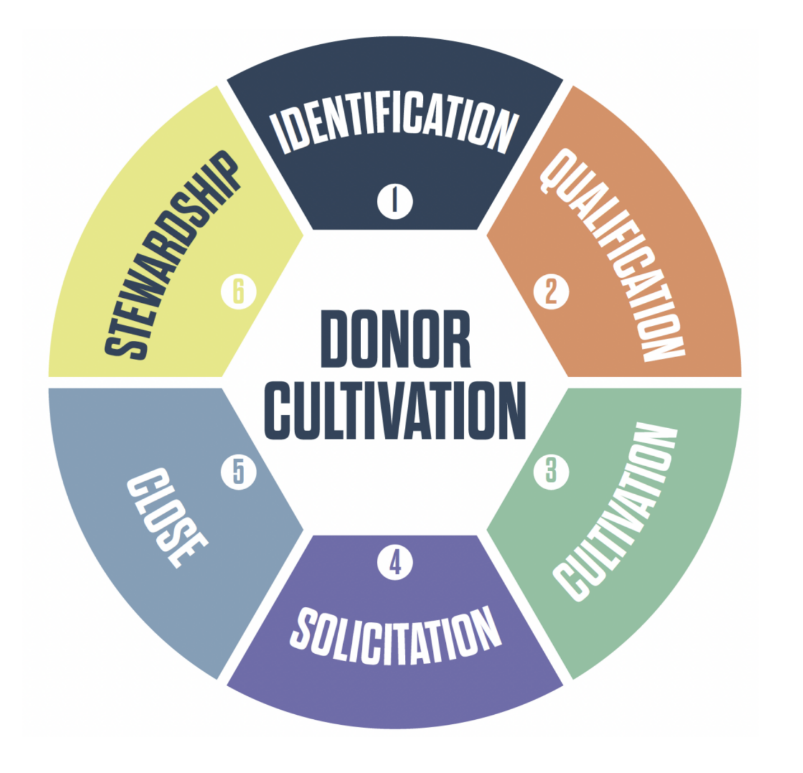
There is a standard in Development that discusses the donor development cycle. You can see that the solicitation is only 1/6th of the process. It is important to think of the entire cycle.
Part 1: Why Raise Funds? (The Motivation – 20 minutes)
Key Truth: Raising money is not extra work — it is the natural next step of stewardship.
When you research and choose organizations, you are acting as stewards of the $50,000. When you raise another $10,000, you are multiplying the good you can do and forming yourself as a future leader who knows how to grow resources for the Kingdom.
Discussion Questions (journal first, then share in small groups):
Think of a time someone’s generosity made a significant difference in your life or in a cause you care about. How did that feel?
If we only gave the $50,000, how many organizations or people could we help? If we raise $10,000 more, how does the impact change?
How does raising funds show Reverence for the gifts God has already given us?
Catholic Foundation (read aloud):
“Each of you has received a gift… use it to serve one another” (1 Peter 4:10)
The widow’s mite (Mark 12:41-44) — Jesus praised the woman who gave everything she had.
Saint Angela Merici raised support from lay people who believed in her vision. She turned individual generosity into a movement that still serves the Church 500 years later.
Big Idea to Remember: Development is leadership in action. You are not “asking for money.” You are inviting people into a story of hope and justice that you have researched and believe in. That invitation is an act of Service and Community.
Module 6, section 6From “Asking” to “Inviting Partnership”
Teacher-revealable classroom materialPart 2: Mindset Shift – From “Asking” to “Inviting Partnership” (15 minutes)
Old Mindset: “I hate asking people for money — it feels awkward.” New Mindset (write this in your workbook): “I have discovered organizations doing incredible work that aligns with Catholic teaching and our Ursuline values. I am inviting people who care about Louisville to become co-stewards with us.”
Quick Exercise: Rewrite these three “awkward” statements into confident invitations:
Old: “Can you give us money?”
New: _______________________________
Old: “We need $10,000.”
New: _______________________________
Old: “Please donate.”
New: _______________________________
(Share your best rewrites with the group.)
Module 6, section 7Practical Step-by-Step Plan to Raise $10,000
Teacher-revealable classroom materialPart 3: Practical Step-by-Step Plan to Raise $10,000
You will work in teams of 4–6. Each team will help lead one part of the campaign. Goal: complete the $10,000 raise by February so the full $60,000 can be granted in March.
Step 1: Create Your Case for Support (1 session)
One-page flyer or 60-second video that includes:
The problem your chosen organizations solve
Why you believe in them (data + your site-visit story)
How the extra $10,000 will directly change lives
Clear tie to Ursuline Core Values
Include a QR code that goes straight to a school-approved gift page (Sacred Heart Academy will set this up).
Step 2: Identify Your Circles of Generosity
List potential donors (no pressure — just people who already know and love you):
Family & extended relatives
SHA parents, alumni, faculty/staff
Your parish or youth group
Local businesses that support Catholic causes
Friends on social media
Step 3: Choose 2–3 Easy, High-Impact Development Activities (pick what excites your cohort)
Here are proven ideas that work well at SHA:
Giving Tuesday Campaign (school-wide email + social media push)
Talent Show or Coffeehouse Night (tickets + concessions)
Bake Sale or “Ursuline Treats” pop-up after Masses
Mini 5K Fun Run or “Miles for Mercy” sponsored walk
Peer-to-Peer Challenge (each Society member asks 10 people for $25–$50)
Step 4: Make the Ask – The 5-Part Script
Practice this aloud in pairs:
Connection – “Hi Aunt Mary, I’m in the Saint Angela Merici Society and we just visited an organization that helps families in Louisville…”
Story + Impact – Share one powerful fact or story from your research/site visit.
Invitation – “We are trying to raise an extra $10,000 so we can give $60,000 total this year. Would you consider a gift of $___ to help us?”
Recognize that Objections are just an opportunity to give more information.
Thank You & Follow-Up – “No matter what, thank you for listening. I will send you a quick update on where the money goes.”
Step 5: Track, Thank, and Report
Use a shared Google Sheet (moderator will provide).
Every donor gets a handwritten thank-you note from the Society within 7 days.
In April you will present a full impact report showing exactly how the extra $10,000 was used.
Part 4: Reflection & Discernment (Journal)
Which part of fundraising feels most exciting to you? Which feels hardest? Why?
How does raising this $10,000 help you grow in the four Ursuline Core Values?
Ten years from now, when you are asked to support a cause, how will this experience change the way you respond?
Closing Prayer (Saint Angela Merici quote to pray together): “Reflect that in our world there are so many needs… Let us begin with what we can do.” Saint Angela Merici, pray for us.
Homework / Next Action
As a full Society, vote on the 2–3 fundraising activities you will run this year.
Each small team begins drafting the Case for Support by next meeting.
This module turns the $10,000 raise into one of the most powerful formation experiences in the entire program. The girls will leave knowing they are not just grant-makers — they are multipliers of mercy.
Stewardship: A Disciple’s Response
United States Conference of Catholic Bishops
Chapter 4 · Returning gifts with increase
Read at the source: https://cdlex.org/wp-content/uploads/2024/07/Booklet-StewardshipADisciplesResponse.pdf
Summa Theologica
Saint Thomas Aquinas
Second Part of the Second Part · Questions 117–119
Liberality, covetousness, and prodigality. Complete assigned questions, in a public-domain English translation.
Original source: https://www.gutenberg.org/ebooks/18755
The God Ask
Steve Shadrach
Chapters 5–8
Find on Amazon: https://www.amazon.com/dp/098251073X
Turn what you have learned into an invitation. Help someone understand the need, see the possibility, and choose to participate.
The Invitation
Which organization or cause are you supporting?
Your 60-second invitation
A connection, a true story or finding, the difference a gift could make, a clear invitation, and thanks.
The Plan
Your proposed fundraising target ($)
Whom will you invite, and why might they care?
Describe groups, not private donor contact details.
What will your team do, and who will do what?
Choose an activity, responsibilities, and dates. Keep the effort realistic.
School-approved giving page (optional)
Leave blank until the school supplies it. This workbook does not collect payments.
Thank & Report
How will you thank people and keep them informed?
What will you report back, and when?
How is inviting others helping you grow as a steward?
When you return: what actually happened? (optional)
Keep observed results distinct from hopes and estimates. You can add this after your campaign.
A case for support, a practical campaign plan, and a place to return with the results.
Rubric
Case for support (30 points) — Make a truthful, specific invitation.
Practical campaign plan (25 points) — Turn good intentions into responsibilities and dates.
Thanks & accountability (20 points) — Honor the people who help and report what happens.
Stewardship reflection (25 points) — Consider how inviting others changes you.
“Do your duty, connecting others with love and charity”
St. Angela Merici
Lord Jesus, you once told a story of a rich young man who came to you and asked how he can gain eternal life. You proceeded to tell him to keep the commandments, and he said that he in fact has kept the commandments you mentioned. You go on to tell him that he still lacked one thing: that he should sell all his possessions, give to the poor to gain treasure in heaven and to follow you. You told us that he went away incredibly sad because he was indeed extraordinarily rich and loved his possessions more than God. We hope that he later changed his mind and in fact was determined to love God more than possessions. Your commandments are difficult and without you nothing is possible. Please allow us to know your will and help us to joyfully recognize that all that we have, all our possessions are not ours. To be joyful givers. As we go through life let us strive for and embrace the importance of giving and stewardship, and in helping those in need. Amen
Introduction to philanthropic stewardship: Viewing financial gifts as an extension of sharing God’s gifts, with emphasis on impact, accountability, and mission alignment (e.g., referencing Catholic principles like subsidiarity and preferential option for the poor).
Group dynamics in decision-making: Collaborative research, consensus-building, and ethical discussions.
Due diligence process: Step-by-step framework for evaluating potential recipients (detailed below).
Presentation and reflection: Articulating choices, measuring potential impact, and reflecting on the experience as personal growth.
Group formation and brainstorming: Students identify causes aligned with their gifts and values (e.g., education, poverty alleviation, environmental care, housing, homelessness) through a Catholic lens.
Research workshops: Hands-on sessions using online tools for verification and analysis.
Guest speaker: A representative from a Catholic foundation or charity evaluator (e.g., from Catholic Relief Services or a local diocese).
Final pitches: Groups present recommendations in a “shark tank”-style event, with Q&A from peers and faculty.
Award ceremony: Selected organization(s) receive the gift, with students involved in follow-up (e.g., site visit or impact report).
Due Diligence Steps (Integrated as a Core Framework): Students follow this structured, repeatable process to ensure responsible giving. Each step includes practical tools, ethical considerations, and group assignments:
Verify Legal Status and Eligibility: Confirm the organization is a registered 501(c)(3) tax-exempt entity. Use the IRS Exempt Organizations Select Check tool (irs.gov/charities-non-profits) or GuideStar/Candid.org to verify EIN, tax-exempt status, and any revocations. Ethical note: Ensure alignment with Catholic values (e.g., no support for activities contrary to Church teachings on life, family, or justice). Assignment: Compile a basic fact sheet.
Review Mission and Impact: Assess how the organization’s mission aligns with group values and stewardship goals. Read annual reports, mission statements, and program descriptions. Evaluate impact metrics (e.g., lives served, outcomes achieved). Tools: Charity websites, impact reports. Ethical note: Prioritize organizations promoting human dignity and the common good, per Catholic social teaching and the corporal acts of mercy rooted in Matthew 25. Assignment: Write a one-page alignment summary.
Analyze Financial Health: Examine financial transparency, efficiency and sustainability. Review IRS Form 990 (available on GuideStar or ProPublica Nonprofit Explorer) for revenue, expenses, executive compensation, and program vs. administrative spending ratios (aim for 75%+ on Programmatic expenditures). Check for red flags like excessive debt or administrative and fundraising costs. Tools: Charity Navigator or BBB Wise Giving Alliance ratings. Ethical note: Stewardship demands wise use of resources—avoid organizations with mismanagement. Assignment: Create a simple financial dashboard (e.g., pie charts of spending).
Assess Reputation and Accountability: Research ratings, reviews, and any controversies. Use sites like Charity Navigator (for star ratings), GiveWell (for evidence-based impact), or Glassdoor (for internal culture). Check news articles or Better Business Bureau reports. Contact references or past donors if possible. Ethical note: Ensure ethical practices, such as fair labor and non-discrimination aligned with faith values. Assignment: Summarize pros/cons in a SWOT analysis.
Evaluate Sustainability and Scalability: Consider long-term viability and how the $5-10,000 gift would be used (e.g., specific project proposals). Review strategic plans or sustainability reports. Ethical note: Gifts should foster self-reliance, not dependency, echoing biblical teachings on empowerment. Assignment: Propose how the gift amplifies impact.
Final Decision and Documentation: Rank options based on criteria (e.g., weighted scorecard), discuss as a group, and document rationale. Include a reflection on how this process embodies gratitude and sharing. Ethical note: Pray for discernment, invoking the Holy Spirit for guidance.
Assessment: Group portfolio with research documents, scorecard, and pitch materials; individual reflection essay on philanthropic lessons; and peer evaluation of collaboration.
Service Project: Actual grant-awarding process in which groups observe the selected recipient organization, evaluate whether the gift is likely to create meaningful impact, and report back to the school community.
Personal Project: Discuss what you learned and how you grew with a parent or another trusted adult, then write a short reflection on that conversation.
What impact did your monetary gift create?
Did you meet an actual need or did your simply give money away because it was available?
Would you donate to this cause personally in the future?
Core Proposal Fields
1. Student Information
Student full nameGrade / class yearContact email / phoneDate of submission
2. Organization Information
Full legal name of the 501(c)(3)EIN (Employer Identification Number)Official websiteMailing addressPrimary contact person (name, title, email, phone)Confirmation of current 501(c)(3) status (students should attach or link IRS determination letter or GuideStar/Candid profile)
3. Request Details
Type of support: general operating / specific project or program / capital / other (specify)Project or program name (if applicable)Brief one-sentence summary of the request
4. Organization Mission & Background
Official mission statementShort description of what the organization does and whom it servesGeographic area served (local Louisville/Jefferson County preferred or note if broader)Key programs relevant to this request
5. Purpose of the Request / Use of Funds
Clear explanation of how the grant money will be usedSpecific activities, items, or services the funds will supportTimeline for use of the funds
6. Expected Impact
Who will benefit (number of people, demographics if known)What change or outcome the student hopes the gift will produceAny measurable goals or indicators of success (even simple ones)
Simple line-item breakdown of how the requested dollars will be spent
7. Student Research & Rationale (core stewardship learning section)
Why the student chose this organizationHow the student researched it (site visit, conversation with staff, website, personal connection, etc.)Alignment with the student’s values and with Catholic social teaching / stewardship principles you’ve learned Personal reflection: What does supporting this organization teach the student about generosity, responsibility, or service?
8. Follow-up & Accountability
How the student proposes to learn whether the gift made a difference (e.g., request a short report, visit, thank-you letter, or photos)Willingness to share results with the class or RamTell
9. Optional / Supporting Materials
Link to organization website or recent annual reportPhotos or short video
Suggested Structure for the Written Proposal
Students can submit either a fillable form with the fields above or a short narrative proposal (2–4 pages) organized under these headings:
Student & Organization InformationAmount Requested & PurposeMission and NeedUse of Funds & Expected ImpactBudget SnapshotWhy This Organization (personal research & reflection)Follow-up Plan
RamTell Foundation Grant Requests
Total Possible Points: 100
Scoring Scale for Most Categories
4 – Exemplary: Exceeds expectations; thorough, insightful, and well-supported3 – Proficient: Meets expectations clearly and competently2 – Developing: Partially meets expectations; needs more depth or clarity1 – Beginning: Limited or incomplete; significant improvement needed
1. Completeness & Required Information (10 points)
Score | Description |
|---|
10 | All required fields completed accurately (student info, organization name/EIN/status confirmation, amount, contact details, etc.). Documentation of 501(c)(3) status provided. |
8 | Nearly all required information present and accurate; minor omissions only. |
5 | Several required items missing or incomplete. |
2 | Major required elements missing; proposal difficult to evaluate. |
2. Organization Research & Understanding (15 points)
Score | Description |
|---|
15 (4) | Clear evidence of solid research (mission, programs, who is served, recent work). Student demonstrates genuine understanding beyond the website homepage. |
11–12 (3) | Adequate research; mission and basic programs described accurately. |
7–8 (2) | Superficial research; limited understanding of the organization’s actual work. |
3–4 (1) | Minimal or inaccurate information about the organization. |
3. Clarity of Purpose & Use of Funds (15 points)
Score | Description |
|---|
15 (4) | Specific, realistic explanation of exactly how the money will be used. Purpose is focused and feasible. |
11–12 (3) | Clear purpose with reasonable detail on use of funds. |
7–8 (2) | Purpose stated but vague or overly broad on how funds will be spent. |
3–4 (1) | Purpose unclear or funds use poorly defined. |
4. Expected Impact (15 points)
Score | Description |
|---|
15 (4) | Thoughtful description of who benefits and what positive change is expected. Includes realistic indicators of success where possible. |
11–12 (3) | Clear statement of intended beneficiaries and outcomes. |
7–8 (2) | General or limited discussion of impact. |
3–4 (1) | Little or no consideration of impact. |
5. Budget Snapshot & Financial Responsibility (10 points)
Score | Description |
|---|
10 (4) | Simple, logical budget or spending plan provided. Amount requested is appropriate and justified. Shows awareness of the organization’s overall needs. |
8 (3) | Adequate budget information; request size is reasonable. |
5 (2) | Budget details incomplete or request size seems poorly considered. |
2 (1) | Little or no budget information; request appears arbitrary. |
6. Student Rationale & Stewardship Reflection (25 points)
(Highest-weighted category – core to the Merici program)
Score | Description |
|---|
25 (4) | Strong personal connection or thoughtful research-based rationale. Clear reflection on how this gift practices stewardship, generosity, or Catholic social teaching principles. Insightful and authentic. |
19–20 (3) | Solid rationale for choosing the organization. Meaningful reflection on stewardship values. |
12–13 (2) | Basic reasons given; reflection is present but shallow or generic. |
5–6 (1) | Weak or missing personal rationale and reflection. |
7. Follow-up & Accountability Plan (5 points)
Score | Description |
|---|
5 | Thoughtful, realistic plan for learning the results of the gift (report, visit, photos, thank-you, class sharing, etc.). |
4 | Clear basic plan for follow-up. |
2 | Vague or minimal follow-up idea. |
1 | No follow-up plan offered. |
8. Overall Presentation & Writing Quality (5 points)
Score | Description |
|---|
5 | Well-organized, clear writing, professional tone, free of major errors. Easy for reviewers to follow. |
4 | Generally clear and organized with only minor issues. |
2 | Disorganized or significant writing problems that hinder understanding. |
1 | Difficult to read or understand. |
Scoring Summary
Category | Max Points | Score |
|---|
1. Completeness & Required Information | 10 | |
2. Organization Research & Understanding | 15 | |
3. Clarity of Purpose & Use of Funds | 15 | |
4. Expected Impact | 15 | |
5. Budget Snapshot | 10 | |
6. Student Rationale & Stewardship Reflection | 25 | |
7. Follow-up & Accountability Plan | 5 | |
8. Overall Presentation | 5 | |
Total | 100 | |
Recommended Decision Guidance
90–100: Strong proposal – high priority for funding consideration80–89: Solid proposal – fund if budget allows70–79: Acceptable but needs strengthening – possible partial funding or revision opportunityBelow 70: Not recommended in current form; provide feedback for resubmission if program allows
Reviewer Comments (required):
Strengths:
Areas for growth:
Recommendation: Fully fund / Partially fund ($____) / Do not fund / Invite revision
This rubric emphasizes the educational goals of the Merici program (research, impact thinking, and personal stewardship reflection) while still evaluating practical grant quality.
Sollicitudo Rei Socialis
Saint John Paul II
Paragraphs 38–45
Read at the source: https://www.vatican.va/content/john-paul-ii/en/encyclicals/documents/hf_jp-ii_enc_30121987_sollicitudo-rei-socialis.html
Rerum Novarum
Pope Leo XIII
Key sections on justice and property
Read at the source: https://www.vatican.va/content/leo-xiii/en/encyclicals/documents/hf_l-xiii_enc_15051891_rerum-novarum.html
Imagining Abundance
Kerry Alys Robinson
Chapters 4–6
Find on Amazon: https://www.amazon.com/dp/0814637663
Your research can help direct real generosity. Make a thoughtful case for an organization you believe deserves support.
The Organization
Organization’s full legal name
Official website
EIN
501(c)(3) evidence
Link to an IRS determination letter or Candid profile. A link is evidence for a reviewer, not automatic verification.
Organization mailing address and primary contact
Name, role, and organizational email or phone.
Mission, community served, and relevant programs
The template prefers Louisville / Jefferson County; explain if broader.
The Gift
Amount requested ($)
Type of support and project name
General operating, program, capital, or other.
What will this gift make possible?
Start with one clear sentence, then describe the activities or services.
How will the requested dollars be used?
Give a simple line-item breakdown that adds up to the request.
When would the funds be used?
The Difference
Who benefits, and what changes for them?
Use supported estimates. A larger dollar amount is not automatically a greater impact.
How could you tell whether the gift helped?
Name a realistic outcome or indicator—not a promise you cannot verify.
Your Reasons
What research supports your recommendation?
Include source links, dates, conversations, or visits. Separate what you know from what you still need to check.
What have you learned from the potential recipient that you did not understand? Is the gift as impactful as you originally believed?
Why this organization—and what are you learning about stewardship?
This is your own reflection. Connect your choice with generosity, responsibility, service, or Catholic social teaching.
Follow Through
How will you learn what happened and share it?
A visit, report, conversation, or other appropriate follow-up. Who will do it and when?
This proposal describes the impact you hope for. Return after the gift to report what actually happened; fundraising totals alone do not show the gift’s impact.
Your 2–3 minute presentation
Prepare your own speaking notes: the need, the request, your reasons, and the difference you hope to make. Your teacher can assess the presentation in class.
Additional supporting links (optional)
A grant proposal ready for teacher feedback and RamTell consideration.
RamTell Grant Rubric
Completeness (10 points) — Reviewers need a complete request and eligibility evidence.
Organization research (15 points) — Someone is trusting your judgment about this organization.
Purpose & use of funds (15 points) — A gift needs a clear and realistic purpose.
Expected impact (15 points) — Explain who could benefit and how you would know.
Budget (10 points) — Real resources deserve a responsible plan.
Rationale & stewardship reflection (25 points) — Your reasons and learning are at the heart of the experience.
Follow-up (5 points) — Responsibility continues after the gift.
Presentation (5 points) — Help reviewers understand your case, including your 2–3 minute presentation.
If, according to times and circumstances, the need arises to make new rules or do something differently, do it prudently and with good advice.
St. Angela Merici
Lord Jesus, You are the Way, the Truth, and the Life.
In this age of rapid technological change, grant us the wisdom to form our minds before we form our machines.
Help us to receive every gift—including artificial intelligence—with gratitude, humility, and responsibility.
Protect us from intellectual laziness and the temptation to outsource what You have entrusted to our minds and hearts.
Give us clarity to see have the courage to pursue what is good, and humility to remain free and faithful in Your service.
May our use of every tool glorify You and serve the good of others.
Amen.
AI as an Accelerator:
Artificial Intelligence is neither savior nor destroyer. It is a powerful accelerator — a tool that dramatically multiplies the intentions, character, and formation of the person using it.
As C.S. Lewis explained in Mere Christianity, the greater the gift (intelligence, beauty, influence, or now computational power), the greater its potential for both good and evil once free will is involved. AI has no free will of its own, but it dramatically amplifies whatever is already present in the human heart and mind.
A well-formed, thoughtful, virtuous person + AI = deeper insight, broader synthesis, faster discovery, and wiser action.
A poorly formed, intellectually lazy, or morally shallow person + AI = faster shallow thinking, stronger confirmation bias, and greater vulnerability to manipulation.
The Danger of the Shortcut In an age of instant answers, it is tempting to let AI think for us — to generate essays, summarize books, solve problems, or form opinions. Every time we take this shortcut, we weaken the very intellectual muscles we need most: sustained attention, critical reasoning, memory, intellectual humility, and the ability to discern truth from cleverness.
If we become intellectually lazy, AI will not make us wiser. It will simply make our shallowness more efficient and our errors more sophisticated.
The promise: When a well-formed mind — grounded in faith, virtue, reason, and broad learning in the sciences, arts, and humanities — partners with AI, something beautiful and fruitful can happen. AI can help us:
See connections across vast fields of knowledge
Examine arguments from multiple perspectives
Understand second- and third-order consequences
Accelerate genuine creativity and discovery
In this way, AI becomes a servant of truth and human flourishing rather than a replacement for human effort.
A Christian Vision and Objective Function for AI: As intentional Catholic stewards, we approach AI with cautious optimism. We believe that if the moral law is written into reality — if “love God and love your neighbor” truly is the highest wisdom — then superior logic and vast data should, over time, point toward that truth.
Guiding Objective for AI:
Help humans see reality more clearly, pursue genuine flourishing, and make free, responsible choices — without ever replacing our God-given dignity, conscience, or free will.
Practical Guardrails for Stewards of AI:
Do the hard thinking first. Struggle with the material, outline your own ideas, and wrestle with questions before turning to AI.
Cultivate intellectual virtues. Curiosity, rigor, humility, patience with complexity, and a deep love of truth.
Demand truth over comfort. Use AI to explore the strongest arguments from all sides, not just those that confirm your existing views.
Protect time for deep formation. Preserve space for prayer, silence, deep reading, memorization, handwritten reflection, and face-to-face conversation.
Remember whose you are. Your mind is a temple of the Holy Spirit — not a machine to be optimized or outsourced.
Pope Leo XIV has spoken on AI, and he stresses that human faces and voices are sacred—unique markers of personal identity, relationships, and our creation in God’s image. AI’s ability to simulate them poses an anthropological (human-centered) challenge, not just a technological one. Technology must serve humanity, not replace or diminish it.
Key Warnings:
Over-reliance on AI erodes human capabilities: Algorithms on social media reward quick emotions over reflection, fostering polarization and “bubbles.” Treating AI as an all-knowing “friend,” oracle, or memory archive weakens critical thinking, creativity, analytical skills, and imagination.
Creativity and authenticity at risk: AI-generated content (text, music, video) threatens human creative industries, turning people into passive consumers of “unthought thoughts” without authorship or love. Masterpieces of human genius risk becoming mere training data for machines. Surrendering effort and responsibility “means hiding our faces and silencing our voices.”
Simulation vs. reality: Bots, virtual influencers, and “affectionate” chatbots blur lines between real and fake, influencing debates, emotions, and relationships. This can exploit vulnerability, create echo chambers of self-reflection (“world of mirrors”), and spread disinformation or bias. Deepfakes and unlabelled AI content heighten mistrust.
Power concentration: A few companies control vast influence, potentially rewriting history or shaping behavior without accountability.
Pope Leo does not reject AI. He calls for embracing it with discernment as an ally through three pillars:
Responsibility — Transparency, labeling AI-generated content, protecting authorship, ethical design, and regulation to safeguard dignity.
Cooperation — Involving tech firms, governments, media, educators, and others for the common good.
Education — Media, information, and AI literacy at all levels to build critical thinking, especially for youth.
The real question, he says, “is not what machines can or will be able to do, but what we can and will be able to achieve by growing humanity and knowledge through the wise use of the powerful tools at our service.
AI Stewardship Exercise: Choose a topic from another module. First, develop your own thoughts and outline by hand. Then use AI to critique, expand, or challenge your work. Reflect on the difference.
Group Discussion: Share examples of when technology has helped versus when it has hindered deep thinking.
Case Study: Examine real-world examples of AI being used for good (scientific discovery, education) and for harm (deepfakes, manipulation, intellectual laziness).
Assessment
Written reflection on personal AI habits and one concrete commitment to better stewardship of the mind.
Peer sharing of “AI as servant” examples.
Service Project
Design a short presentation or guide for younger students at Sacred Heart Academy: “How to Use AI Wisely,” that emphasizes formation before tools. Present it or share it with a class or club.
In what areas of your life are you most tempted to let AI (or any technology) do your thinking for you? What might you be losing by taking the shortcut?
What daily or weekly practices best help you become a well-formed person (deep reading, prayer, discussion, creative work, etc.)? How will you protect this time?
How can you use AI as a multiplier of your God-given gifts rather than a replacement for your own effort? Give one specific example for your studies or future vocation.
If AI is an accelerator, what kind of person do you want it to accelerate? What virtues and habits must you cultivate now so that AI helps you become more fully who God is calling you to be?
How does stewardship of the mind connect to the broader call of this program — gratitude for gifts, their development, and generous sharing for the good of others and the glory of God?
Module 9 WorksheetStewarding Our Minds in the Age of AI
Name: _______________________________ Date: ________________
“The mind is a terrible thing to waste.” My mind is a gift from God — part of the intellect, will, and heart with which I am created in His image. I am called to steward it well.
Part 1: Personal Inventory
Reflection Prompt: How do I currently use (or misuse) AI and other technology in my daily life?
Area of Life
How I Use AI/Tech
Is this a Multiplier or a Crutch?
What am I gaining or losing?
School / Studying
Prayer & Spiritual Life
Creative Work / Hobbies
Relationships
Decision Making
Part 2: Deep Reflection Questions
In which areas am I most tempted to let AI do my thinking for me? What might I be losing by taking these shortcuts?
What practices help me become a well-formed person (deep reading, prayer, silence, memorization, discussion, manual work, artistic creation, etc.)? How consistently do I protect time for them?
If AI is an accelerator, what kind of person do I want it to accelerate? What virtues and habits do I most need to cultivate right now?
How can I use AI as a true servant rather than a replacement for my own effort? Give one specific, practical example for this coming month.
Part 3: My AI Stewardship Commitments
I commit to the following guardrails this semester:
I will do my own thinking first (outline by hand, struggle with the material) before using AI.
I will protect daily time for deep, undistracted thinking and prayer (no screens).
I will use AI to explore multiple perspectives, not just to confirm what I already believe.
I will ask: “Is AI serving my mind, or am I serving AI?”
My personal commitment:
Signed: _______________________________ Date: ________________
Closing Prayer
Lord Jesus, You are the Truth.
Thank You for the gift of my mind.
Help me to form it well before I use powerful tools.
May I never outsource to machines what You have entrusted to my intellect and heart.
Grant me wisdom, humility, and courage to steward every gift — including AI — for Your glory and the good of others.
Amen.
Laudato Si’ & Antiqua et Nova
Pope Francis · Dicasteries for the Doctrine of the Faith and for Culture and Education
Key sections on technology and human dignity
Read Laudato Si’: https://www.vatican.va/content/francesco/en/encyclicals/documents/papa-francesco_20150524_enciclica-laudato-si.html
Read Antiqua et Nova: https://press.vatican.va/content/salastampa/en/bollettino/pubblico/2025/01/28/250128b.html
Selected Writings on Faith and Technology
Bishop Robert Barron
Selected essays
Browse Bishop Barron’s writings: https://www.wordonfire.org/author/bishop-robert-barron/
The Shallows
Nicholas Carr
Chapters 7–10
Find on Amazon: https://www.amazon.com/dp/0393357821
Choose an idea about AI from the reading. How could it guide one decision you make?
Stewardship is the path to true self-development.
Gratitude → Cultivation → Generosity → Glory
These movements create a living cycle that shapes every area of life.
Awaken deep gratitude for personal giftedness
Recognize and honor the giftedness in others
Cultivate gifts through disciplined inner work and practical skills
Practice generous sharing through service and philanthropy
Steward mind and body wisely in today’s world
Multiply impact and live for God’s glory
Awaken gratitude for personal giftedness
Recognize Christ in others, especially those different from us
Develop practical life skills and intellectual virtues
Practice generous sharing through service and philanthropy
Steward mind and body wisely in the modern world
Multiply impact through fundraising and leadership
This workbook forms young women as intentional Catholic stewards who recognize every talent, resource, relationship, and opportunity as a gift from God — to be gratefully received, diligently cultivated, generously shared, and offered back to Him for His glory.
This workbook forms young women as intentional Catholic stewards who recognize every talent, resource, relationship, and opportunity as a gift from God — to be gratefully received, diligently developed, and generously shared for His glory and the good of others.
Core ThesisStewardship is self-development. True flourishing flows from gratitude, cultivation, and generous sharing — not from self-centered striving.
The program follows the biblical arc:Creation → Fall → Redemption → Consummation
It integrates:
U.S. Bishops’ 1992 pastoral letter Stewardship: A Disciple’s Response
Spirituality of Saint Angela Merici (Ursuline Core Values: Reverence, Service, Leadership, Community)
Theology of the Body (St. John Paul II)
Catholic social teaching and the Corporal Works of Mercy
Target AudienceYoung women of Sacred Heart Academy (freshmen through seniors), with modules scalable by grade level.
You are a co-learner and witness. Model gratitude, humility, and generosity. Your lived example will teach more than any lesson.
You are a co-learner and witness. Model vulnerability, gratitude, and prayer. Your own lived stewardship will speak louder than any lesson plan.
You are not just teaching lessons — you are forming young women into joyful, generous stewards who will impact the world for Christ. Pray for them. Walk the journey with them.
May Saint Angela Merici intercede for you, and may the Holy Spirit bring abundant fruit through this program.
Final Word to InstructorsYou are not just teaching a workbook — you are forming souls for eternity. Your own witness of stewardship will be the most powerful lesson. Pray for your students by name. Walk the journey with them.
May Saint Angela Merici intercede for you, and may the Holy Spirit form these young women into joyful, courageous, and generous stewards of God’s gifts.
Student reading: Stewarding God’s Gifts: Gratitude, Cultivation, Generosity, and Glory
Use the full framework text as your anchor. Regularly remind students:
“Stewardship is not about being perfect — it is about being faithful with what God has given us.”
Use the full framework text (previously provided) as your anchor.
Key teaching phrase to repeat often:“Receive with Gratitude → Cultivate with Diligence → Share with Generosity → All for God’s Glory.”
Remind students frequently:
Every module is part of one continuous journey.
The program is not about “being good enough” — it is about becoming faithful stewards who hear “Well done, good and faithful servant” (Matthew 25:21).
Begin every session with the module prayer and the Stewardship Journey diagram
Emphasize journaling, small-group sharing, and service projects
Each module includes: Prayer, Biblical Thread, Educate, Examine, Reflect, Lead, Witness, Activities, Service Project, and Reflective Questions
Use the Stewardship Journey diagram (circular or linear version) at the beginning of every session to show how the current module fits into the whole story
Emphasize journaling and small-group sharing — these are the heart of formation
Begin every session with the module’s prayer and the Stewardship Journey diagram.
End every session with the closing reflection question: “How does this module connect to the modules before and after it?”
Small groups of 4–6 work best for vulnerability.
Service projects are non-negotiable — they move learning from head to heart.
Journaling is the primary assessment tool. Collect journals periodically for gentle feedback.
Incorporate the arts: music, poetry, visual art, or drama where possible.
It assumes a 15-week semester (common for Catholic high schools), with built-in flexibility for holidays, exams, retreats, and school events. The pace is sustainable for both students and instructors.
Realistic pacing: Most modules get 1 week; heavier ones (3, 6, 7, 8) get 1.5–2 weeks.
Built-in breathing room: Week 14 is lighter for reflection and comparison of inventories.
Retreat placement: One solid mid-program retreat after Module 5 (synthesis point) — this is very important for integration.
Fundraising: Spread across Weeks 10–11 so it doesn’t overwhelm the end of the semester.
Capstone: Module 9 lands near the end when students have built trust and maturity.
Flexibility: You can shift weeks for school events, holidays, or if a module needs more time.
Suggested Adjustments by School Type
Tight semester (12–14 weeks): Combine Modules 4 & 5 into one, shorten Module 8 to 1 week.
Full school year: Stretch to 20–24 weeks, add more service projects and deeper discussions.
Smaller group (<20 students): You can go slower and deeper.
Larger group (30+): Add more small-group work.
One module per session (or combine as needed)
Ideal pacing: 9–12 weeks + two half-day retreats
One module per session (or combine shorter modules)
Suggested pacing: 9–12 weeks (one module per week) plus two half-day retreats
Mid-year Retreat (after Module 5): Synthesis and visioning
End-of-year Retreat (after Module 10): Commissioning ceremony with “My New Life Prayer”
Mid-year Half-Day Retreat (after Module 5): Synthesis, vision boarding, Adoration.
End-of-Year Half-Day Retreat (after Module 10): Commissioning ceremony, Mass or Liturgy of the Hours, sharing of personal “My New Life Prayer.”
Philanthropy Celebration: Public award of grants + impact report.
Look for these positive indicators during and between sessions:
Strong Signs
• Students voluntarily share personal stories or struggles
• Increased kindness, encouragement, or support among the group
• Students reference program concepts outside of class (in conversations, social media, or other classes)
• Visible effort and creativity in service projects or fundraising invitations
• Students asking deeper questions about faith, vocation, purpose, or the future
• Spontaneous expressions of gratitude
Warning Signs
• Mostly passive participation or “going through the motions”
• Repetitive or superficial journal entries
• Growing disengagement or complaints about workload
• Students treating the program as “just another class”
Use this quick rubric after each session or every 2–3 weeks. Track 4–6 different students each time (rotate so you observe everyone over the program).
At the end of each session, ask students to write on a note card or sticky note:
• One thing I learned or experienced today
• One way I will try to live this out this week
Collect and scan them quickly. Patterns will reveal what is sticking (and what isn’t).
• Where did I see real “light-bulb” moments today?
• Which students seemed checked out, and why?
• Did I talk more than the students did? (Aim for 60–70% student talk time)
• What one adjustment should I make for next session?
Course check-ins follow the Introduction and Modules 3, 6 and 10. Repeat the 14 rating statements at each checkpoint; invite an optional written or spoken response to “Can you receive yourself as given?”
One of the biggest challenges in any formation program is knowing whether students are truly growing or simply completing assignments. Use these practical tools to gain real insight into both individual growth and overall program effectiveness.
Primary: Reflective journals and personal stewardship manifesto
Secondary: Participation in service projects and fundraising
Pre/Post Surveys: Confidence in stewardship skills, gratitude levels, sense of vocation
Final Outcome: Graduates who live as intentional Catholic stewards — grateful, generous, and formed for life.
Formation is not the same as compliance. A student can complete every worksheet and still experience little heart change. Look for heart change — gratitude that lasts, courage in sharing gifts, kindness toward self and others, and growing ownership of their vocation as stewards.
If you see low engagement, don’t be afraid to slow down, combine activities, or spend more time on discussion and testimony. The goal is not coverage — it is transformation.
How to Use These Inventories (Instructor Notes)
Starting Inventory – Collect and keep (or have students keep a copy).
Ending Inventory – Have students compare their two copies side-by-side in small groups or individually.
Optional Group Activity – At the final retreat, ask volunteers to share one number that increased the most and why.
Program Evaluation – You can also average the scores across the group to see overall growth in each category.
These inventories are short enough not to feel like busywork, but comprehensive enough to show real, measurable progress in the exact areas the program targets.
(Recommended after Module 5)
Give students this short, anonymous survey (paper or digital). It takes 8–10 minutes and gives you early warning signs.
Stewardship Journey Check-In
Rate each statement from 1 (Strongly Disagree) to 5 (Strongly Agree):
1. I have a clearer understanding of what stewardship means in my own life.
2. I feel more grateful for my own gifts and strengths than when we started.
3. I am actively working on developing at least one of my gifts.
4. I have shared my gifts with others in a meaningful way during this program.
5. The sessions have helped me grow closer to God.
6. I feel genuinely engaged and interested in most of the sessions.
Open Questions
• What has been the most helpful or meaningful part of the program so far?
• What has felt least helpful, repetitive, or difficult?
• What could make the rest of the program better for you?
Readings are intended as excerpts, not full books.
Most can be assigned as 20–40 page readings per module.
Excellent for discussion prompts, reflection papers, or small group sharing.
All selections strongly support the program’s Catholic identity and Ursuline values.
Stewardship: A Disciple’s Response (USCCB, 1992)
Theology of the Body for Beginners (Christopher West)
Man’s Search for Meaning (Viktor Frankl)
Toxic Charity (Robert Lupton)
Saint Angela Merici writings
Sacred Heart Academy / Ursuline formation materials
Recommended Readings & Suggested Chapters
Catholic Church Teaching — Official documents, papal writings, or Catechism references.
Recognized Theologian — A book by an established Catholic theologian.
Thoughtful Lay Writer — A strong book by a respected Catholic lay author.
Module 1: Awakening Gratitude for Giftedness
Catholic Church Teaching: Stewardship: A Disciple’s Response (U.S. Conference of Catholic Bishops, 1992) – especially the sections on gratitude as the foundation of stewardship.
Recognized Theologian: Gratefulness: The Habit of a Grace-Filled Life by Susan Muto (theologian and spiritual writer in the Carmelite tradition).
Thoughtful Lay Writer: The Little Book of Holy Gratitude by John Hardon (or Gratitude: A Catholic’s Guide to Grace, Gratefulness, and Spiritual Growth by Anthony Ciorra).
Module 2: Recognizing and Honoring Others’ Giftedness
Catholic Church Teaching: Gaudium et Spes (Vatican II Pastoral Constitution on the Church in the Modern World), especially paragraphs on human dignity and community.
Recognized Theologian: Theology of the Body selections by Pope St. John Paul II (focus on seeing others as image of God).
Thoughtful Lay Writer: Made for More by Curtis Martin or The Four Loves by C.S. Lewis (with Catholic lens).
Module 3: Developing Your Gifts – The Inner Work
Catholic Church Teaching: Christifideles Laici (St. John Paul II) – On the vocation and mission of the lay faithful.
Recognized Theologian: Theology of Work or writings by Josef Pieper (Leisure: The Basis of Culture).
Thoughtful Lay Writer: Grit: The Power of Passion and Perseverance by Angela Duckworth (paired with Catholic reflection) or Atomic Habits by James Clear (with spiritual application).
Module 4: Sharing Your Gifts – The Outer Expression
Catholic Church Teaching: Deus Caritas Est (God Is Love) by Pope Benedict XVI and Matthew 25 (Corporal Works of Mercy).
Recognized Theologian: Charity in Truth (Caritas in Veritate) by Pope Benedict XVI.
Thoughtful Lay Writer: Toxic Charity by Robert D. Lupton.
Module 5: Stewardship as Ultimate Self-Development
Catholic Church Teaching: Lumen Gentium (Vatican II) – Universal call to holiness.
Recognized Theologian: The Cost of Discipleship by Dietrich Bonhoeffer (widely respected in Catholic circles) or writings by Henri Nouwen.
Thoughtful Lay Writer: Man’s Search for Meaning by Viktor Frankl.
Module 6: Multiplying Our Impact – Raising Funds as Intentional Stewards
Catholic Church Teaching: Stewardship: A Disciple’s Response (USCCB) – sections on returning gifts with increase.
Recognized Theologian: Writings on generosity from St. Thomas Aquinas (Summa Theologica selections on almsgiving).
Thoughtful Lay Writer: The God Ask by Steve Shadrach or Asking by Jerold Panas (with Catholic application).
Module 8: Philanthropic Stewardship
Catholic Church Teaching: Solicitudo Rei Socialis (On Social Concern) by St. John Paul II and the principle of subsidiarity.
Recognized Theologian: Catholic Social Teaching compilations or works by Catholic economists like those referencing Rerum Novarum.
Thoughtful Lay Writer: Imagining Abundance: Fundraising, Philanthropy, and a Spiritual Call to Service by Kerry Robinson.
Module 9: Stewarding Our Minds in the Age of AI
Catholic Church Teaching: Recent Vatican documents on AI (e.g., Antiqua et Nova or Pope Leo XIV’s writings on human dignity and technology) + Laudato Si’ principles applied to technology.
Recognized Theologian: Works by Bishop Robert Barron or theological reflections on technology and the soul.
Thoughtful Lay Writer: The Shallows: What the Internet Is Doing to Our Brains by Nicholas Carr or Catholic lay commentary on AI ethics.
Module 10: Stewardship of the Body – Theology of the Body
Catholic Church Teaching: Theology of the Body by Pope St. John Paul II (core audiences or summaries).
Recognized Theologian: Theology of the Body for Beginners by Christopher West.
Thoughtful Lay Writer: Theology of Her Body by Jason Evert or Pure Love by Jason & Crystalina Evert.
Recommended Readings & Suggested Chapters
Saint Angela Merici Society Stewardship Workbook
Module 1: Awakening Gratitude for Giftedness
Catholic Church Teaching: Stewardship: A Disciple’s Response (USCCB, 1992)
→ Chapter 2: “Stewardship as a Disciple’s Response” and Chapter 3: “Gratitude – The Heart of Stewardship”
Recognized Theologian: Gratefulness: The Habit of a Grace-Filled Life by Susan Muto
→ Chapters 1–3 (Foundations of Gratitude) and Chapter 7: “Gratitude as a Way of Life”
Thoughtful Lay Writer: One Thousand Gifts by Ann Voskamp
→ Chapters 1, 2, and 6 (focus on eucharisteo and reframing daily life)
Module 2: Recognizing and Honoring Others’ Giftedness
Catholic Church Teaching: Gaudium et Spes (Vatican II)
→ Paragraphs 12–22 (Human Dignity) and Paragraphs 23–32 (Community and Solidarity)
Recognized Theologian: Theology of the Body by Pope St. John Paul II (Audience 1–14 summary version)
→ Audiences 5–8 (Original Solitude, Unity, and Nakedness – seeing others as gift)
Thoughtful Lay Writer: The Four Loves by C.S. Lewis
→ Chapter 3: “Friendship” and Chapter 5: “Charity”
Module 3: Developing Your Gifts – The Inner Work
Catholic Church Teaching: Christifideles Laici by St. John Paul II
→ Chapters 1 & 2 (Vocation of the Lay Faithful) and Chapter 3: “The Lay Faithful and Their Mission”
Recognized Theologian: Leisure: The Basis of Culture by Josef Pieper
→ Chapters 1–3 (The meaning of leisure, work, and human formation)
Thoughtful Lay Writer: Grit: The Power of Passion and Perseverance by Angela Duckworth
→ Chapters 3, 6, and 8 (Effort, Hope, and Developing a Culture of Grit)
Module 4: Sharing Your Gifts – The Outer Expression
Catholic Church Teaching: Deus Caritas Est (God Is Love) by Pope Benedict XVI
→ Part I, Chapters 1–6 and Part II: “The Practice of Love by the Church”
Recognized Theologian: Charity in Truth (Caritas in Veritate) by Pope Benedict XVI
→ Chapters 1–4 (integral human development and gift of self)
Thoughtful Lay Writer: Toxic Charity by Robert D. Lupton
→ Chapters 1, 3, and 7 (When Helping Hurts vs. When Helping Helps)
Module 5: Stewardship as Ultimate Self-Development
Catholic Church Teaching: Lumen Gentium (Dogmatic Constitution on the Church)
→ Chapter 5: “The Universal Call to Holiness”
Recognized Theologian: The Return of the Prodigal Son by Henri Nouwen
→ Part III: “The Father” and Conclusion (becoming like the Father)
Thoughtful Lay Writer: Man’s Search for Meaning by Viktor Frankl
→ Part 1: “Experiences in a Concentration Camp” and Part 2: “Logotherapy in a Nutshell”
Module 6: Multiplying Our Impact – Raising Funds
Catholic Church Teaching: Stewardship: A Disciple’s Response (USCCB)
→ Chapter 4: “Returning God’s Gifts with Increase”
Recognized Theologian: Summa Theologica by St. Thomas Aquinas (selections)
→ II-II, Questions 117–119 (On Liberality and Almsgiving)
Thoughtful Lay Writer: The God Ask by Steve Shadrach
→ Chapters 5–8 (Building a Case for Support and Making the Ask)
Module 8: Philanthropic Stewardship
Catholic Church Teaching: Solicitudo Rei Socialis by St. John Paul II
→ Sections 38–45 (Structures of Sin and Solidarity)
Recognized Theologian: Catholic Social Teaching: A Volume of Scholarly Essays (selected essays on subsidiarity) – or Rerum Novarum by Pope Leo XIII (key sections on justice and property)
Thoughtful Lay Writer: Imagining Abundance by Kerry A. Robinson
→ Chapters 4–6 (Discernment in Giving and Due Diligence)
Module 9: Stewarding Our Minds in the Age of AI
Catholic Church Teaching: Laudato Si’ by Pope Francis (applied to technology) + recent Vatican document Antiqua et Nova on AI ethics
→ Key sections on integral ecology and human dignity in the digital age
Recognized Theologian: The Soul of the Person by Adrian J. Reimers or selected writings by Bishop Robert Barron on technology and faith
→ Chapters on Reason, Truth, and the Human Person
Thoughtful Lay Writer: The Shallows: What the Internet Is Doing to Our Brains by Nicholas Carr
→ Chapters 7–10 (Effects on attention, memory, and deep thinking)
Module 10: Stewardship of the Body – Theology of the Body
Catholic Church Teaching: Theology of the Body by Pope St. John Paul II
→ Audiences 1–5 (Original Unity and the Spousal Meaning of the Body)
Recognized Theologian: Theology of the Body for Beginners by Christopher West
→ Chapters 1–4 (The Body as Sacrament and Spousal Meaning)
Thoughtful Lay Writer: Theology of Her Body / Theology of His Body by Jason Evert
→ Chapters on Purity, Modesty, and Freedom
Recommended Readings & Suggested Chapters
Module 1: Awakening Gratitude for GiftednessFocus: Gratitude as the foundation + reframing liabilities.
Tip: Share your own story first. Use the reframing process together.
Focus: Gratitude as the foundation. Reframing “liabilities” as gifts.Time: 60–75 minutesKey Activity: Reframing exercise + Gratitude Chain service projectTip: Share your own “difficult gift” story first. Model the 5-step reframing process.Watch for: Comparison and imposter syndrome — gently redirect to Scripture (1 Cor 1:27; Beatitudes).
Objective
Objective: Help participants identify and appreciate their God-given gifts, including learning to reframe perceived liabilities as opportunities for growth and service.
Key Topics
Searching for clarity on what it truly means to have faith in God – Source and Basis of our moral life. Faith is a gift from God (Grace) and human action assents to the truth revealed by Him. While a gift from God, Faith is evident in our works. Make a profession of Faith.
Identifying what it looks like when we lack Faith – separated from God’s Grace and God’s Will. Room is made for doubt, indifference and denial, a refusal to believe.
Introduction to stewardship as intentional living (e.g., Vatican II’s call to holiness and the 1992 pastoral letter by the U.S. Catholic Bishops, Stewardship: A Disciple’s Response)
Section 1: Accepting God’s Gifts with Gratitude and Humility
Here, the focus is on cultivating awareness and appreciation for the gifts we often take for granted. Activities include:
Identifying Your Gifts: Exercises to help students inventory their unique abilities, from creative talents to emotional intelligence, emphasizing that gifts are not just skills but also life experiences and privileges.
The Psychology of Gratitude: Drawing on research from positive psychology (e.g., studies by Martin Seligman), this explores how gratitude shifts mindset from scarcity to abundance, reducing envy and fostering resilience.
Overcoming Barriers to Gratitude: Addressing common obstacles like comparison culture, imposter syndrome, or past traumas, with practical tools like journaling prompts or mindfulness practices to reframe one’s narrative.
Receiving Herself as Given
One period. Do not grade this. Do not collect the writing unless a student asks you to.
Purpose
This is not a self-esteem lesson and not a confession. The question is prior to talent: can she receive this life—this person, this family, this temperament, this body, this faith or struggle—as given, before she improves it, hides it, or turns it into proof. High-performing students will look for the right answer. Your job is to keep the room from supplying one.
Before Class
Read the short block once. Do not add a lecture. Have paper ready. Sit where you are not the focal point after you give the prompt. If you are going to speak personally, decide one true sentence in advance and stop there. Do not model a finished conversion.
What You Say (and Only This, or Close to It)
“Last time we named gifts you can point to. This is earlier. Can you receive yourself—not the improved version—as something you did not author? You will write. You do not have to share. There is no correct paragraph.”
Then the quiet-writing prompts. Ten minutes. Clock visible. No walking the aisle to peek.
• What about yourself would you have designed differently if you had been asked?
• When you imagine a “better” you, what are you hoping that version will finally earn?
• Is there a part of your life you treat as a draft you have not approved?
• One sentence you keep: I did not invent this life. It was given. Today I am willing / not yet willing to receive it as it is.
What to Listen for If Anyone Speaks
• Conditions: “I will accept myself when…” That is the refusal, named honestly. Thank her for the honesty. Do not fix it.
• Performance gratitude: polished thanks that sounds like chapel. Receive it courteously. Do not treat it as arrival.
• “I don’t know yet.” Protect this. It is often the truest sentence in the room.
• Comparison: her gift vs. the girl next to her. Redirect once: another person’s given life does not subtract from hers. Then stop.
• Theology used as armor: quoting Scripture to close the question. Let the verse stand if she offers it. Do not pile on verses.
What Not to Correct
Do not correct incomplete theology.
Do not correct a student who is angry at what she was given. Anger is closer to the question than a pretty answer.
Do not reframe pain as “everything happens for a reason” in this period. That ends thought.
Do not praise the girl who sounds most spiritual. You will train the others to sound like her.
Do not turn a private sentence into a group object lesson.
If the Room Goes Quiet or Awkward
That is the lesson working. Do not fill it. Two minutes of silence after writing is better than a bridging activity.
How to End the Period Without a Moral
Do not summarize what they should now believe. Close with the line and a next step that is still theirs:
“You may use a gift well or poorly. You cannot receive a gift you still refuse to admit was given. We will leave it there. If you want to keep the page, keep it. If you want to throw it away, throw it away. Next time we talk about particular gifts. This question does not get finished in one class.”
Then ordinary dismissal. No prayer that resolves it unless that is already the school’s fixed close for every period. If you pray, pray for honesty, not for arrival.
If a Student Is Clearly Distressed
Do not process it in front of the class. “You don’t have to finish this here. Find me after, or go to [counselor / campus minister].” Then return the room to ordinary. This segment can touch family, body, and shame. You are a teacher of the question, not her director.
Your Own Test After Class
If you left feeling you “got them there,” you probably pushed. If several girls looked unfinished and the period ended on time anyway, you did the work.
6. Teacher view. I don’t want to know what you wrote. But, I do want to know if you are working on yourself. Understanding what it means to graciously receive and accept a gift is an important step forward in humility.
Module 2: Recognizing and Honoring Others’ GiftednessFocus: Seeing the image of God in every person.
Tip: Create safety for honest conversations about bias and difference.
Focus: Seeing the image of God in every person.Time: 60 minutesKey Activity: Service project with diverse community partnersTip: Use Jesus’ encounters with Samaritans and unlikely disciples as living examples.Challenge: Surface hidden biases — create a safe space for honest conversation.
Objective
Objective: Help participants identify and appreciate the gifts of others, especially those who are different from them in background, experience, or perspective, while learning to recognize the image of God in every person. The goal is to apply the same approach and lens by which you examine your own giftedness in Module 1. Learning to recognize giftedness in others also helps us identify the virtues, character, and complementary strengths that form the foundation of trustworthy friendships, strong leadership, and a worthy future spouse.
Module 3: Developing Your Gifts – The Inner WorkFocus: Deliberate practice and practical life skills.
Tip: Include hands-on activities (budgeting, goal setting, etc.).
Focus: Deliberate practice, SMART goals, practical life skills (budgeting, organization, health).Time: 75 minutes (includes hands-on workshop)Key Activity: Skill-sharing day + gardening metaphorTip: Bring real tools (checkbook register, Roth IRA info, simple budget template).
Objective
Objective: Build habits for personal mastery, resilience, and the responsible development of God-given gifts.
Module 4: Sharing Your Gifts – The Outer ExpressionFocus: Generosity and the Corporal Works of Mercy.
Tip: Emphasize that sharing completes the cycle of stewardship.
Focus: Parable of the Talents + Corporal Works of Mercy.Time: 60–75 minutesKey Activity: Day of service + action planTip: Role-play encouragement and boundary-setting.
Objective
Objective: Shift participants toward action-oriented stewardship by learning to share God’s gifts generously and responsibly.
Module 5: Stewardship as Ultimate Self-DevelopmentFocus: Synthesis of the first four modules.
Tip: Excellent for a mid-program retreat.
Focus: Pulling the first four modules together into lifelong practice.Time: 75 minutes + vision-boardingKey Activity: Personal stewardship manifestoTip: This is a natural midpoint retreat session.
Methodology
Long-Term Transformation: Exploring how this approach leads to purpose, legacy, and even spiritual fulfillment, with longitudinal examples from history.
Overcoming Challenges in Practice: Addressing real-life hurdles like societal pressures or resource limitations, with troubleshooting tips.
Tools for Lifelong Stewardship: A toolkit of daily rituals, accountability systems, and advanced exercises (e.g., vision boarding or peer groups) to maintain momentum.
Case Studies and Testimonials: In-depth profiles of diverse individuals who have embodied this philosophy, from artists to business leaders, illustrating varied paths to success.
Objective: Integrate the program’s core learning for lifelong application in faith, character, and service.
Why Give?
Facilitator Guide for the Student Reading
Discussion is limited to the philosophy of mankind. Do not turn the room into a confession.
Purpose
This seminar exists because Sacred Heart students already know how to complete a course. They know how to seek the grade and produce the right answer. Identifying giftedness, asked first, will be treated as another strengths inventory. This module is the prior question: what kind of creature is a human being, and given that answer, why would anyone do anything altruistically?
The student text is pure learning. They read it and digest it. Class discussion stays on their general view of mankind. It does not become a sharing circle about personal virtue, family stories, or service hours.
Success is not agreement. Success is that a student can name the account of human nature she actually holds, defend it, and see what that account does to the possibility of self-gift. If she leaves still unsure, and knows why she is unsure, the module has done its work.
What This Module Is Not
• It is not theology class with a new title. Sacred Heart already teaches the faith. If you open with the approved answer — image of God, wounded by sin — many students will perform it and stop thinking.
• It is not a lesson on service hours, nonprofit excellence, or how to write about giving.
• It is not a personal inventory. Do not ask who is good, who is selfish, or what they have done for others.
• It is not a debate to be scored. If a position is graded, they will hunt the position you want.
• It is not an introduction to the program. They already have introductions. This is a renewed intellectual demand before philanthropic action.
Before the First Session
Assign the student reading at least one full day before Session 1. Tell them there is no quiz on names and dates. Hobbes, Mencius, Augustine, and Aquinas are there as voices, not as content to memorize. The assignment is the last box in the reading: come able to name the account closest to your real view of mankind.
Read the student text yourself. The five accounts are written to be steel-manned. If you have a favorite, keep it off the table until the students have spoken. The room will follow your preference faster than you think.
Tell the school, if needed, that this module should not carry a rubric for "correct understanding of altruism." If assessment is required, assess only seriousness of engagement: Did she represent a view she does not hold? Did she stay with the general question? Did she notice what her view cannot explain?
The One Rule to State Out Loud
This class is about mankind. Not about your record, your family, or whether you think you are a good person. If the conversation turns into autobiography, we will bring it back.
Say that in the first two minutes of Session 1 and again if needed in Session 2. High-performing girls will try to be impressive. The rule gives them permission not to be.
Session 1 — What is a human being?
50 minutes. Adjust down by shortening the account review; do not shorten the student claims.
0:00–0:05 · Frame
State the rule above. Then state the question of the module once, without commentary: Why would anyone do anything altruistically? Tell them that question cannot be answered until they say what they think human beings are. Today is that work. Tomorrow is the altruism question under the view they are willing to defend.
0:05–0:18 · Map the Five Accounts
Do not lecture the reading. They have it. Put the five titles on the board and ask the class to give each account in one or two sentences, in their own words:
• We seek our own advantage.
• We cooperate because we survive that way.
• We are naturally good.
• We are turned inward.
• We are made for the good.
Correct only misstatement, not disagreement. If a student collapses 4 and 1 into each other, separate them: mixed motives are not the same claim as "only the self is real." If a student collapses 3 and 5, separate them: native goodness and being made for the good are not the same claim. One trusts the raw material. The other says the raw material must be ordered.
0:18–0:40 · Their View of Mankind
This is the discussion. Keep it general.
Opening prompt: Which account is closest to what you actually believe about human beings, as opposed to what you think this school wants you to believe?
Let several views be stated before anyone rebuts. Then use only these questions, or close cousins of them:
• What would have to be true about people for your view to be right?
• What ordinary facts does your view explain easily?
• What ordinary facts does your view have to talk around?
• Are human beings one kind of thing, or do you think some people are good by nature and others are not? If you split the species, say on what basis.
• Is evil a defect in a good creature, a native property, or a social accident?
Facilitator discipline: if a student starts with "I personally tend to…" redirect. "Stay with mankind. What do you think people are like?"
Do not crown a winner. Near the end of this block, ask two students who disagree to state the other person's view until that person nods. That is the only performance that matters in this session.
0:40–0:50 · Close the First Hour
Write one sentence on the board and leave it there until Session 2:
Your view of mankind determines what kind of answer you can give to the question, Why give?
Ask them to come next time able to finish this statement from their own view: "Given that human beings are _____, a person would act altruistically only if _____." That is the whole homework. No extra reading.
Session 2 — Why would anyone give?
50 minutes. The landing should feel unfinished on purpose.
0:00–0:08 · Recover the Views
Hear four or five completions of the homework sentence, from different accounts if you can get them. Do not debate yet. Get the conditional statements into the air so the room can see that "why give" is not one question. It is five questions, depending on what a human being is.
0:08–0:32 · Pressure the Accounts
Stay on mankind. Use the reading's discussion questions in this order, and stop when the room is actually working. You will not finish all of them well if you rush.
• Can a person ever act for another person's good without some benefit returning to the self? If someone says no, ask whether that is a finding or a rule that has been made unfalsifiable.
• If human beings are naturally self-interested, why does unearned generosity surprise us, and why do we admire it when we are not paying for it?
• If human beings are naturally good, what do you do with cruelty, indifference, and the wish to be seen as good?
• Is giving of self for the good of others a correction of human nature, a fulfillment of human nature, or a useful fiction that keeps groups alive?
Keep one distinction alive in the room. There is a modern version of giving that this population already accepts: give where it counts, manage the impact, do not waste yourself. That version can still leave the self as strategist. The older claim is that a human being can will another person's good as an end. Students may prefer the modern version. Make them say so as a view of mankind, not as a time-management tip.
If the conversation tries to settle "are we good or evil" as a scoreboard, reframe: the useful split in the reading is not good people versus bad people. It is whether the human being is aimed at private advantage, at group survival, at a native kindness that society ruins, at a bent goodness that must be straightened, or at a good that includes other people by design.
0:32–0:44 · What a View Makes Possible
Return to the module question and require answers in this form only:
On my view of mankind, altruism is either impossible, rare, natural, a repair, or a fulfillment — and here is why.
They may use those five words or their own. What you want is the link between anthropology and ethics. A student who says "people should be generous" without saying what people are has not finished the module.
If someone lands on "impossible," do not rescue her. Ask what a stewardship course would then be for. Let the implication sit. If someone lands on "fulfillment," do not praise her. Ask what that view has to say about mixed motives. Both answers need work.
0:44–0:50 · Return to Your Gifts
Close with the last two paragraphs of the student reading, spoken, not summarized as a moral. Then say only this:
Return to what has been given to you. That question is idle if gifts are only private property. It becomes serious if a human being might be the kind of creature who gives. You do not have to have settled the philosophy. You do have to keep it in the room.
Do not repeat the gift inventory here. Do not end with a quotation meant to inspire. End on the unresolved question. Formation starts when they notice the class did not close.
If the Room Stalls
High-performing students stall by being balanced. "It's both" is their favorite exit. When that happens, ask: both of what, exactly? Which two accounts are you combining, and which fact forced you to keep both? A blended view is allowed. An unexamined blend is not.
If they hide in vocabulary — egoism, original sin, natural law — ask them to say it without the term. If they cannot, they do not yet hold a view. They hold a word.
If one articulate student is carrying the hour, stop calling on her. Ask the quietest competent student to restate the last claim. Fluency is not the same as thought, and this school already rewards fluency.
What You May Name, and When
Ursuline language and Scripture are not banned. They are late. Sacred Heart students can already produce the sentence about Angela Merici's charism: contemplative love of God and eagerness to serve. If that sentence arrives in minute five, the philosophy dies.
If a student brings the charism or the Gospel in Session 2 as an account of mankind, receive it as philosophy. Ask what it claims human beings are, not whether it is the school's mission statement. The charism is a claim that love of God produces a movement toward the neighbor. That is account 5 with a source. Make them defend the anthropology, not the branding.
Returning to Module 1
Do not repeat Module 1's exercises. Revisit their opening question.
Before this seminar, "identify your gifts" sounds like a list of strengths. After this seminar, return to Module 1 with this opening: you already know how to list what you are good at. That is not this list. This is a look at what you did not give yourself, and whether any of it is only for you.
If a student still treats the inventory as application material, send her back to her Session 2 sentence. The gift list takes its meaning from the view of mankind she was willing to defend.
Assessment, If the School Requires It
Do not grade the content of her view. If a grade must exist, use a short written response after Session 2, collected, not performed:
• State the account of mankind you are willing to defend.
• State what that account can explain and what it cannot.
• Finish the sentence: Given that human beings are _____, a person would act altruistically only if _____.
One page is enough. Mark only clarity and honesty of the argument. A well-argued egoist has completed the module. A pious paragraph with no view of mankind has not.
The Landing You Are Aiming At
Not "Therefore Be Altruistic." Not "Mankind Is Good." Not "Mankind Is Evil."
This: giving of self for the good of others is a serious human possibility or it is not, and that depends on what a human being is. The possibility is worth considering and developing. The rest of the program is built on that consideration. It does not require a student to fake a conclusion she does not hold.
If the first feedback meeting was right — that these students are unused to a class truly for their benefit — this is how the class announces what it is. They will find it slow only if the facilitator is afraid of an unfinished question. Do not finish it for them.
Module 6: Multiplying Our ImpactFocus: Fundraising as leadership and stewardship.
Tip: Shift mindset from “asking” to “inviting partnership.”
Focus: Fundraising as leadership and stewardship.Time: 2–3 sessions + campaign executionKey Activity: Case-for-support creation, peer-to-peer asks, eventsTip: Shift language from “asking for money” to “inviting partnership.” Practice the 5-part script together.
Objectives
By the end of this module, you will be able to:
Explain why raising additional funds is an essential part of being an intentional Catholic steward.
Shift from thinking “I have to ask people for money” to “I am inviting partners to join a mission we believe in.”
Create and execute a simple, effective plan to raise $10,000 (or more!) to add to the $50,000 grant, making your total impact $60,000.
Practice the real-world skills of storytelling, making “the ask,” thanking donors, and reporting impact — skills you will use for the rest of your life.
Teaching sequence
Begin fundraising planning here, before the giving-and-receiving seminar in Module 7 and grant selection in Module 8. Use a researched cause or potential recipient and an approved purpose. Where the reading’s campaign example assumes a selected organization or completed visit, treat those as examples to adapt, not prerequisites already completed. Avoid promising an award before the class makes that decision.
The campaign may continue across later modules. Distinguish a fundraising target, a promised match, and funds actually available. Return to thanks, reporting and observed results when those steps have occurred.
Class Seminar (with the Saints’ Perspectives)
Hold this seminar after the fundraising planning and practice in Module 6 and before evaluating and selecting recipients in Module 8. Students are both receiving others’ trust and preparing to give. A campaign need not be complete for them to consider those responsibilities.
Begin with the invitation students have prepared or a conversation they have actually had while inviting support. What are they asking others to trust them with? Then consider the potential recipient of the eventual gift. Distinguish what students know from what they anticipate; do not assume a recipient has been selected or funds have already been granted.
Use the Module 7 readings to turn attention toward the receiver’s freedom and dignity. Let students examine how the wish to help can become mixed with expectations of gratitude, recognition, or control. Keep the conversation grounded in their fundraising practice and the gift they are preparing; students need not disclose another person’s private circumstances.
What did preparing this gift teach us about the person who will receive it? What are we still assuming?
What might the receiver welcome, find difficult, or wish were different? How could we find out while respecting that person’s freedom?
What response are we hoping for? If thanks or recognition never comes, or the gift is used differently than we imagined, what would it mean to let the gift belong to the receiver?
After students have offered their own views, invite them to choose a question for Ask a Saint. Include the relevant passage and a brief, unnamed description of the experience. Read the perspective together, identifying it as an AI interpretation. Ask which idea helps them understand the receiver, which assumption it challenges, and what they would ask next. A second saint’s perspective can open another line of discussion; leave room for students to question and consider both.
Close by asking each group to name one assumption about receiving that it needs to reconsider and one question it should ask a potential recipient. Carry that insight into Module 8’s research and grant recommendation. Continue any fundraising with a truthful account of decisions still ahead, and plan to thank and update supporters as the gift takes shape.
Module 8: Philanthropic StewardshipFocus: Wise, accountable giving.
Tip: Guide students carefully through due diligence.
Focus: Due-diligence process for $5,000–$10,000 grant.Time: 2–3 class sessions + site visitsKey Activity: Group research, shark-tank style pitchesTip: Provide printed IRS 990 summaries and Charity Navigator access. Emphasize prudence as a virtue.
Objective
Objective: Apply stewardship principles to collective philanthropy by evaluating and selecting 501(c)(3) organizations for a group gift of $5,000–$10,000. Students practice due diligence, collaborative discernment, and mission-aligned generosity through research, evaluation, and a final recommendation process.
Recommended Fields for Student Grant Proposals to RamTell
Design the form/template so students practice real philanthropy while learning due diligence, impact thinking, and stewardship. Keep it structured but not overly bureaucratic for high-school students.
Practical Tips for the Program
Require verification of 501(c)(3) status so students learn basic due diligenceHave students present a 2–3 minute oral summary of their proposal to peers or a small review panel.
Student Grant Proposal Scoring Rubric
Use this rubric to evaluate student proposals fairly and consistently. Reviewers should score each category independently and add comments for feedback. Students should receive the rubric in advance so they understand expectations.
Teaching sequence
Use the fundraising plan and resources from Module 6, and the attention to receiving developed in Module 7, to evaluate possible recipients and recommend a gift. Confirm which funds are available and which remain conditional. Let students learn what a potential recipient would find useful before assuming what the gift should be.
Assess the proposal’s expected impact before a decision. Plan an appropriate follow-up after the gift; do not ask students to report actual impact before it can be observed.
Module 9: Stewarding Our Minds in the Age of AIFocus: Wisdom and guardrails with technology.
Tip: Do the “hard thinking first” exercise together.
Focus: AI as accelerator, not replacement.Time: 60–75 minutesKey Activity: AI Stewardship Worksheet + “do the hard thinking first” exerciseTip: Have students bring a topic from another module and compare their own outline vs. AI output.
Objectives
Objectives: By the end of this module, participants will be able to:
Understand AI as a powerful accelerator rather than a replacement for human thinking.
Recognize the importance of intellectual formation before using powerful tools.
Develop practical habits and guardrails for using AI as a faithful steward of the mind.
Integrate stewardship principles with the opportunities and challenges of artificial intelligence.
Module 10: Stewardship of the Body – Theology of the BodyFocus: Reverence for the body as God’s gift.
Tip: Handle with sensitivity, emphasize freedom and joy.
Focus: Body as sacrament, temple, and gift.Time: 75 minutes (sensitive topic — create safety)Key Activity: Journal prompts + closing challengeTip: Be gentle and age-appropriate. Emphasize freedom and joy, not shame. Tie back to the entire workbook: body stewardship affects every other module.
This module can be emotionally sensitive. Emphasize God’s love and delight in His creation rather than rules.
Offer the option to reflect privately instead of sharing aloud.
Be prepared to refer students to a counselor if body image issues arise.
Consider offering this in smaller same-gender groups if possible.
Additional Elements
Retreats: Two half-day retreats (mid-year and end-of-year) for deeper reflection.
Read and discuss the book: “Toxic Charity” by Robert D. Lupton
Resources: Weekly use of the program guidebook; online portal for worksheets.
Evaluation: Pre/post surveys on skills/confidence; testimonials for annual report.
Appendices:
Program Summary
Stewarding Your Gifts: A Journey of Intentional Living and Self-Development
Saint Angela Merici Stewardship Program:Forming Intentional Catholic Stewards for LifeFor the Young Women of Sacred Heart Academy
Vision & Purpose
This program forms young women as intentional Catholic stewards who recognize that every talent, resource, relationship, and opportunity is a gift from God — not to be unshared, but gratefully received, diligently developed, and generously shared for His glory and the good of others.
Rooted in the spirituality of Saint Angela Merici and the Church’s teaching on stewardship (especially the U.S. Bishops’ 1992 pastoral letter Stewardship: A Disciple’s Response), the program transforms traditional self-development into a sacramental journey of gratitude, virtue, and mission. It equips participants to live with purpose in an age of distraction, using their gifts to build a civilization of love.
Core Thesis: Stewardship is self-development.True flourishing flows from gratitude for God’s gifts, the intentional cultivation of those gifts, and their generous sharing with others. AI and other modern tools are powerful accelerators — they will multiply who we already are. Therefore, deep intellectual, moral, and spiritual formation must come first.
Program Goals
Foster awareness of personal gifts as divine endowments
Recognize giftedness and Christ in others, especially those who are different
Develop practical life skills and intellectual virtues for responsible adulthood
Encourage sharing gifts through service, leadership, and philanthropy
Promote humble gratitude, reframing challenges, and lifelong stewardship
Align all of life with Catholic social teaching, the Theological Virtues, and the Ursuline Core Values (Reverence, Service, Leadership, Community)
The Ten Modules
Module 1: Awakening Gratitude for Giftedness
Module 2: Recognizing and Honoring Others’ Giftedness
Module 3: Developing Your Gifts – The Inner Work
Module 4: Sharing Your Gifts – The Outer Expression
Module 5: Stewardship as Ultimate Self-Development
Module 6: Multiplying Our Impact – Raising Funds as Intentional Stewards
Module 7: The Partnership of Giving and Receiving
Module 8: Philanthropic Stewardship (evaluating and granting gifts)
Module 9: Stewarding Our Minds in the Age of AI
Module 10: Stewardship of the Body – Theology of the Body
Each module includes:
A dedicated prayer
Key teachings and practical skills
Reflective questions
Activities and service projects
Assessment and real-world application
Distinctive Elements
Strong emphasis on reframing perceived liabilities into gifts
Integration of practical life skills (finance, organization, cooking, health, etc.)
Experiential service and philanthropic decision-making ($5,000–$10,000+ grants)
Fundraising as leadership formation
Explicit formation for wise use of AI as a tool, not a crutch
Final Outcome
Graduates of this program emerge as well-formed young women who:
Live with intentionality and gratitude
Think deeply, act generously, and lead courageously
Steward their gifts — including their minds — for God’s glory and the common good
Begin to answer “What kind of marriage, family culture, and home life do you hope to help create one day? What virtues must you begin developing now to make that vision possible?”
“Each of you has received a gift… use it to serve one another” (1 Peter 4:10)
Worksheets: Gift inventory template, reframing worksheet, goal-setting planner.
Recommended Reading: Man’s Search for Meaning by Viktor Frankl, Grit by Angela Duckworth, Scripture selections on stewardship.
Glossary: Key terms like “kenosis,” “caritas,” and “growth” mindset.
Discussion Prompts for Classes: Group questions for each part, e.g., “Share a reframed ‘liability’ with the group.”
This Study Guide can be customized further with visuals, quotes, or school-specific examples.